The Jazz.com Blog
June 03, 2009 · 8 comments
Who Cares About Old Jazz?
Ethan Iverson has spurred an interesting web debate on how well younger musicians know the jazz tradition. He recently chided participants in a piano master class, when none of them were familiar with James P. Johnson’s “Carolina Shout.”
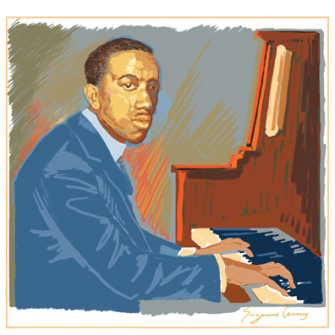
Chris Donnelly, one of the pianists involved in the master class, offers his defense here—insisting that nobody is talking about James P. Johnson these days. Blame the broader culture and the jazz community, not the young musicians.
Hand it to Chris, he not only published his defense and rebuttal to Iverson on the web, but even submitted it in Iverson’s recent “write a jazz blog” competition. Ethan counters with a spirited defense of “Carolina Shout.” Not wanting to miss out on a good fight, Peter Hum jumped into the battle with his own commentary. He writes: "I don't see demonstrating one's ability to play James P. Johnson or stride in general as required proof of a true relationship with the jazz piano tradition."
Iverson is not convinced. He denies "that James P. Johnson’s name is that obscure. I’ve found his name to be inescapable." He goes on to cite chapter and verse, defending Johnson's importance.
I have to side with Iverson on this matter, yet I also note that the contemporary culture does not make much room for people like James P. Johnson. Serious jazz pianists, of any generation, should know this music, but I am not surprised that they don't.
I recently tried to find my CD of James P. Johnson's concert music (he wrote a number of extended works of quasi-classical proportions), and failed to locate it in the maze of compact disks and books that passes for my home; when I went to the web to order a new copy I learned it was out of print. This was really the only decent collection of Johnson's concert works, and it was sobering to learn that it was out of stock and only available from specialty dealers. What hypocrisy, when our nation celebrates "Black Music Month" (which started on Monday, by the way), yet no one cares to keep the music in print! Can you spell L-I-P S-E-R-V-I-C-E?
But "Carolina Shout" is a different matter entirely. It is easy to find, and exerted much more influence on jazz than any of Johnson's concert works. This particular piece was the composition every stride piano player needed to learn (almost as a rite of passage) back in the days of Harlem rent parties. In a way, it was the jazz studies program before there were jazz studies programs. Thus, there is more than a little irony involved when jazz piano students today don’t know about it.
If a player only plans to learn one stride piano piece, this would be the one. By the same token, if you don’t know “Carolina Shout,” it suggests that you don’t have any real conception of piano jazz before bebop, because it would be hard not to run into this song during even the most cursory exploration of pre-WWII jazz keyboard music. Duke learned “Carolina Shout.” Monk learned “Carolina Shout.” Jarrett learned “Carolina Shout” (and played it as an encore at his recent Carnegie Hall concert).
Yet I would suggest that the ignorance of James P. Johnson among younger musicians is a symptom of a larger problem (which I outlined in a recent column): namely that jazz fans these days don’t want to listen to recordings made before the advent of high fidelity sound. If the CD was recorded in 1957 or after, they will check it out. But anything earlier . . . forget it!
In a world that pays more attention to the recording quality than the quality of the music, we lose James P. Johnson, “Carolina Shout,” and a lot else.
P.S. For a good introduction to stride piano, check out Ethan Iverson’s “guest” dozens on the subject here.
This blog entry posted by Ted Gioia
Tags:

I appreciate Ethan's (and by extension, Ted's) points. But my ears prick up when I hear people say "must" or even "should" in instances such as this. Stride was a step in the evolution of jazz piano, and is therefore presumably of interest to serious students of the music. But it's characteristics have been subsumed into the greater whole. There's no need to speak Middle English in order to express one's self in the modern idiom.
Interesting points. I agree with Donnelly's assertion that the world doesn't make a big deal out of Johnson anymore, so he can't be faulted for not knowing "Carolina Shout". If his instructors over 22 years never brought up the pianist, why should he be expected to know Johnson's name or music? Looking at cinema, we now have a generation coming up that has no idea who the Marx Brothers, Laurel & Hardy, or Bob Hope and Bing Crosby were. The generation before them had little or no knowledge of Valentino and Clara Bow. Too much has happened since they were alive and really significant to the culture. Yes, they made an undeniable and lasting impact upon the culture, but their footprints have been covered over by the footprints of hundreds of followers. If people would take the time to explore their legacies, Johnson's included, a world of creative expression would be opened up for them. On the other hand, for everyone who insists that pioneers like Johnson should be part of the canon (and I agree that they should), someone else will turn around and claim that the players who are living, working and breaking new ground today are being neglected in favor of the old guard. There's always an argument to be had somewhere. And really, in dealing with a musical genre that's been recorded for almost a century now, how much can an instructor really cram into the hours available?
As a teacher and composer, I try to touch upon a good representative artist from diverse eras and/or musical styles. It's tough, and you really have to pick and choose in order to effectively communicate to a younger generation.
I agree with Chris Kelsey, and his analogy of speaking "Middle English" is on point. Both Wynton and Branford are constantly harping about the importance of early jazz and knowing all of the precedents in order to have a fully-formed voice in jazz. Some of this seems to be backlash to the situation where all the young alto players are copping Kenny Garrett, all the piano players are copping McCoy/Herbie, in what is kind of a formulaic approach to being modern and hip. I feel the Marsalis brothers go too far in the other direction though: earnest reverence for the early greats, and a desire to incorporate the "purity" of their influence, seems to lead to a kind of studied earnestness. I don't find it the least bit interesting to hear the "finer points" of what Wynton has learned from checking out King Oliver, or what Branford has learned from studying Lester Young. Then again, that is my aesthetic persuasion. Wynton believes that great art is timeless. I believe that art is not independent of its times, and that it speaks directly to the sensibilities and ethos of the times it was created. I admire the art and craftsmanship of Louis Armstrong, but it doesn't resonate with me as a young person alive in the 21st century. It seems, quite frankly- a bit "quaint." What I'd offer as a counterpoint to the Marsalis philosophy of "representing" the jazz tradition is the devil-may-care historical alchemy of Jaki Byard, Sun Ra, and Roland Kirk. They knew all the older music and could summon it at will, but it never came across as studied or attempting to make some sort of point. Oftentimes it was employed with great humor or as a kind of bizarro contrast. I think that kind of post-mod approach is still very relevant (and fun!) today. Just playing a ballad the way Lester Young would approach a ballad though? Leave that to Lester, the document is there.
Ted, excellent points you make. As usual your articles are insightful. Thanks Geoff Lapp
My own POV: The reason scientists keep seeking after the Big Bang is because that's where the "music of the spheres" all started. How could any jazz player not want to know where his own music started?
Thanks for deleting the execrably dumb comments by this "Rab Hines" person. A shame for the whole jazz scene on the net.
Hines again (see above). True, he's trying to spam other jazz blogs with bullshit for quite a few years now ... A sad headcase.