The Jazz.com Blog
July 21, 2009 · 0 comments
Tony Bennett and Diana Krall on DVD
Thomas Cunniffe, an editor and regular contributor at jazz.com, reports on two DVDs focusing on jazz vocalists: Tony Bennett and Diana Krall. T.G.
In the quarter-century since he filmed his low-budget masterpiece The Last Of The Blue Devils, Bruce Ricker has become one of the best-known directors of jazz documentaries. One of Ricker’s frequent collaborators is also one of Hollywood’s biggest jazz fans, Clint Eastwood. So, when Eastwood produces a Ricker-directed documentary on Tony Bennett, the budget is big and the expectations are high.
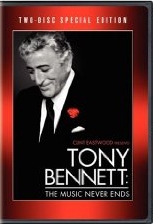
The film is titled The Music Never Ends, and you may have seen it on PBS’ “American Masters” series. Now available on DVD through a partnership between Warners Home Video and Ricker’s company, Rhapsody Video, the film is far from definitive on several levels, but it is loaded with magnificent film clips. The jewel is a 1975 “Tonight Show” appearance where Bennett is accompanied by Bill Evans! What we get to see of the clip includes parts of “When In Rome” and a little bit of an interview with Evans. (According to the Johnny Carson website, Bennett also sang “But Beautiful” with Evans and then sang “Life Is Beautiful” and “S’Wonderful” to fellow guest Fred Astaire! Whatever it costs in clearance rights, this episode of “The Tonight Show” is a classic, and it needs to be released on DVD).
My biggest problem with the documentary is the way that the film clips are used. There’s lot of talking over the music, and in several cases, performance clips of the same song from different eras of Bennett’s career are spliced together. What this is supposed to prove is beyond me—is it somehow relevant that Bennett has sung the same repertoire in the same keys over the years? The treatment of “I Left My Heart In San Francisco” is even stranger: the song, spliced together from several clips, literally stops for interviews, goes again for a bar or two, then stops again for another talking head. It makes the sequence go on forever.
On the other hand, this film was produced through Warner Brothers, and this gave Ricker access to the MGM and Warner’s library of film musicals. So, when Bennett sings “Steppin’ Out With My Baby”, we cut to the Fred Astaire version from Easter Parade and it looks like Fred is dancing to Tony. The same technique is used with Gene Kelly’s “I Got Rhythm” dance from An American In Paris and Busby Berkeley’s dance chorus on “Lullaby Of Broadway” from Gold Diggers of 1935.
The Hollywood influence also rears its head with the choice of interviewees. Harry Belafonte, Bill Charlap and Jonathan Schwartz are all welcome participants, but Mel Brooks and Alec Baldwin? Are these the best people Ricker could find? Baldwin is only here because of a so-so Bennett imitation he did on Saturday Night Live and Brooks’ presence is tied to his appearances with Bennett on The Tonight Show. It’s nice to have an explanatory interview to accompany the clips, but neither of the clips are necessary, especially when there are no clips of Bennett’s landmark appearance on MTV Unplugged.
Of course, Tony Bennett is there throughout the film, and he is perfectly capable of telling his own life story. Like his music, his career stories are still fresh and relevant, no matter how many times you’ve heard them. There are his experiences with the civil rights movement, his triumph at Carnegie Hall and his phenomenal resurgence over the last two decades, all told first-person by Bennett himself.
The 2-DVD set includes a long interview with Bennett and Eastwood (which is better skipped) and a bonus disc, which captures Bennett in extraordinary form at the 2005 Monterey Jazz Festival. Accompanied by his regular band of Lee Musiker (piano), Gray Sargent (guitar), Paul Langosh (bass) and Harold Jones (drums), Bennett sings 14 songs, the highlight of which is an extended version of “In A Mellow Tone” featuring solos by all four sidemen. Bennett is in magnificent voice and every bit the show biz professional. The hand gestures may be corny and the song endings big, but there’s no doubt that Bennett makes every moment count. He is an American treasure.

Diana Krall has toured with Tony Bennett and like the veteran singer, she knows how to effectively program a concert. If you were as disappointed as I was with Krall’s bossa nova album Quiet Nights, you should pick up the DVD, Diana Krall In Rio. Unlike the CD, with its relentless, monotonous program of slow and medium-slow tempos, the DVD presents the Brazilian music as part of a concert. While 9 of the 18 songs on the concert are from the Quiet Nights album, the Brazilian songs are interspersed with lively numbers by Krall’s jazz group: Anthony Wilson (guitar), John Clayton (bass) and Jeff Hamilton (drums).
Krall’s haunting version of “You’re My Thrill”—lost amongst the slow numbers on the CD—benefits from its concert placement between the smoking quartet version of “Cheek To Cheek” and the sobering “Let’s Face The Music & Dance.” When Krall sings three Brazilian standards near the end of the concert, the Rio audience sings along in Portuguese. The ethereal effect is quite stunning on the DVD, and it must have been a spine-tingler in person. The production values are superb with beautiful shots of Rio interspersed with the concert footage. Extras include interviews with Krall, the band members and producer Tommy LiPuma, plus a music video of “The Boy From Ipanema” which recycles much of the Rio location footage from the concert video.
TONY BENNETT: THE MUSIC NEVER ENDS 86 minutes plus 82 minutes supp material.
Warner/Rhapsody 118624. Directed by Bruce Ricker. Produced by Clint Eastwood. With Tony Bennett, Clint Eastwood, Harry Belafonte, Gay Talese, Alan & Marilyn Bergman, Bill Charlap, Everett Raymond Kinstler, Don Rickles, Martin Scorsese, Alec Baldwin, Danny Bennett, Mel Brooks, Stephen Holden, Arthur Penn, Jonathan Schwartz.
DIANA KRALL LIVE IN RIO 110 minutes plus 24 minutes supp material.
Eagle Vision 30273. Directed by David Barnard. With Diana Krall, Anthony Wilson, John Clayton, Jeff Hamilton, Ruria Duprat conducting the Rio De Janeiro Orchestra.
This blog entry posted by Thomas Cunniffe
Tags:

Comments are closed.