The Jazz.com Blog
July 26, 2009 · 0 comments
How to Keep a Festival Afloat
A few days ago, arnold jay smith reported on the music at the Montreal Jazz Festival. But now he looks behind the scenes, and tells us how a huge jazz festival stays afloat in the current economic crisis. T.G.
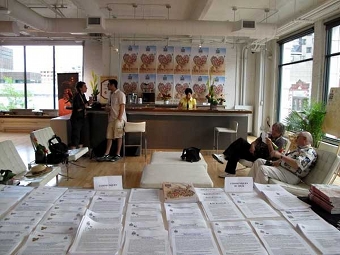
Press Room at the Montreal Jazz Festival
(Kris King Photography)
So how do you like our new digs? That replaced bon jour as a greeting by Andre Menard, co-founder and Artistic Director of the Montral Jazz Festival. I have been running around this place making sure of everything. Everything included the new press floor in the Canadian governments anniversary present to us, an entire building, with a 60-year lease.
The spacious 2nd floor of this former warehouse just off Place des Arts, the site of the festival is now Festival International de Jazz de Montral permanent headquarters. There is a new nightclub on the ground floor, LAstral, where jazz will be presented throughout the year, as well as a restaurant. The club replaces the Spectrum, the converted movie theatre that was torn down last winter. We leased the [Spectrum] property for 25 years and we wanted to buy it and redevelop it. We spent three years and C$1.5 million to redevelop the Spectrum. We were supposed to be given first refusal, but we somehow got by-passed and lost it to another bidder, Menard said. The lot is now a mound of rubble, an eyesore of a construction site, as the new owners have run into financial difficulties.
The plan is to convert the entire street [a block along St. Catherine near Place des Arts] into multi-use living and entertainment, including another tower for Complex de Jardins, he explained. But that guy [who owns those properties] is pretty tough; hes not giving in so fast. Its all paid for so hes in no hurry to sell.
Finances were my main topic of conversation, what with the overcast economic atmosphere. The lead sponsors over the span of time I have been visiting FIJM more than a decadehave gone the way of government banishment: tobacco (du Maurier cigarettes), alcohol (LaBatt Breweries), or, and finally, General Motors. Alcan Rio Tinto is our second level sponsor so [we were looking] for a lead sponsor, Menard explained. They later announced that TD (Toronto Dominion Bank) would be the replacement for GM. Understand that, as this is the main cultural event in Canada, if we didnt replace GM a lot of people would have been in trouble, Menard said.
The FIJM not only set in motion a regular jazz presentation in Montral, it also allowed clubs to open, music stores selling instruments, CDs and live performances to flourish and eventually encouraged others in Ottawa, Toronto and Vancouver to support their own festivals. [Losing FIJM] would certainly cause a serious economic gap, Menard opined. FIJM is the largest in the world and encompasses about a half-mile square of streets closed to vehicular traffic in the center of town, much more this year if you include Stevie Wonders 200,000+ attendance record.
We have been going through some changes, not only recent economic developments, but the government clamp downs on smoking and beer, Menard said. When asked if this or any other festival can survive without corporate sponsorship, Menard shook his head vigorously. Not at all, he said. We depend on sponsorship. We can always reduce its size, cut out the big acts. But we are not in the business of downsizing the festival. We strive to keep it the size it is. We cant grow much in size either. Weve matured to what we are. There are still corporations who want the identification with us. We have proved that we are a very good vehicle for branding.
I asked specifically about JVCs pulling out, a brand compatible with jazz festivals. Perhaps [the JVC Festivals] just outlived its usefulness [for them] on some level, Menard said. After a while a sponsor may think that it is being taken for granted, that they go unnoticed by the public. These corporations do research and the have very precise measurements as to what is profitable and what is not. I cant analyze it, as it is too far from my reality.
Save for the vaunted Stevie Wonder Spectacular, attendance was unimpressive to these eyes probably due to regular rainfall for the entire first week. Menard said otherwise. He thought that the box offices were the same as last year. In the final analysis the official boilerplate press release stated that the goal of C$5.1 million was reached, and with sales of tourist packages, sales at souvenir boutiques and food and beverage kiosks increased. Breaking even these days is a major accomplishment, he quipped. Profitsthe festival is a not-for profitgo into a contingency fund against disasters such as a complete rainout. We have other disaster insurance, such as for the Stevie Wonder, whom, he said, did not cost as big dollars as you might expect. Menard said that the press reports of C$1million for the show, were not true. It cost us less that half that. It cost us the going rate for a medium size arena [concert], and [Wonder] gave us more. It was good night for us and good night for himself, as well.
All the United States artists get paid in US$, what with the fluctuating exchange rate this year. The magic of the festival is that we do two festivals at the same time, inside and out. Inside its rehearsed, sound-checked and the artists get to do full sets. Outdoors is more jamming. However, we cant do it without all the different acts. When we began, even George Wein discouraged us. It was all fusion. Then Wynton [Marsalis] happened. Since then we have diversified and jazz has become more influential. How do we sell it? How do jazz musicians get paid? Thats another story.
What does FIJM do for an encore? Joni Mitchell, Menard snapped back. She is, after all, Canadian.
This blog entry posted by arnold jay smith
Tags:

Comments are closed.