The Jazz.com Blog
July 05, 2009 · 0 comments
A Jazz Fest That Puts Jazz First
While many US jazz festivals are canceled or eliminate jazz from their program, European events thrive without diluting their offerings. Stuart Nicholson recently showed up at the Moers festival in Germany, where he was not the only jazz visitor from afar. He was joined by two big bands from New York (led by Darcy James Argue and Guillermo Klein respectively), a 17-piece ensemble from Brazil, an octet from Seattle and assorted combos from around the world. . . . all in a city with 1/20th the population of Pittsburgh! T.G.
Moers is a small town with a population of just under 120,000 situated in the Ruhr industrial region of Western Germany. It owes its place on the cultural map of Europe to its remarkable music festival that’s been held every Whitsun weekend since 1972. Originally a free jazz festival, today it presents a wide range of music, most of which flies past convenient pigeon holes. Some of it is jazz and some of it has characteristics in common with jazz, but all of it is adventurous. The whole attraction of Moers is its eclectic musical diversity, something that is masterminded by festival producer Reiner Michalke, who trawls the globe to create a program that is a triumph of the unexpected.
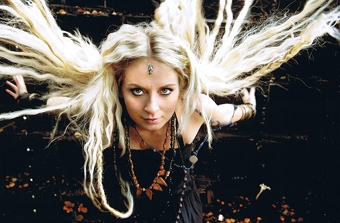
Eivør Pálsdóttir
This is a festival where there’s no safe middle ground. Absent are the familiar faces that annually do the rounds of the festival circuit and in their place a roster of artists that seem specially selected to provoke an extreme emotional response of some kind or other. You never quite know what to expect, and the audiences, including a large chunk of 15 to 30 year-olds, were up for the musical challenge.
Hard to believe we’re in a credit crunch when a big band from Brazil and two from New York are flown in, each for an hour set. The air fares alone could have given Fannie Mae and Freddie Mac a shot in the arm. Add to that an eight piece band from Seattle and six small groups from New York, plus two bands from Norway, one band from the Faroe Islands, one band from Iceland, a trio from Japan, a trio from South Korea, a trio from the Netherlands, a Malawian/French World Music ensemble from Paris plus three groups from Germany and you quickly realise the Moers programme is like no other. Then there’s sixteen small groups (including four flown in from Los Angeles) that appeared at the “Night Session @ Bollwerk 107,” a small late-night space that’s part of the festival programme. Taken together, it adds up to a fascinating snapshot of what is going on around the world today in jazz and improvised music.
Take Eivør Pálsdóttir, for example. She’s a 24 year-old vocalist who lives in the Faroe Isles, and is already a figurehead for the music scene there. The Faroe Islands are rich in Viking mythology and a folkloric history that goes back to Pagan times. “The Chain Dance,” for example, is a 1,000 verse ballad of Pagan origin passed down the generations, and every Faroe Islander seems to have learned a substantial chunk of it, not least Pálsdóttir’s parents. Hardly surprising, then, that she draws on this rich heritage to provide a powerful spine to her music, which is full of mystic folkloric imagery that moves in and out of the darkest parts of the human soul.
Taking simple melodies, she built them into gleaming temples of sound and climaxed them with a stunning falsetto that made every dog in the neighborhood sit bolt upright. A stunning Nordic beauty with long flowing hair, Pálsdóttir’s dress code evoked a Nordic Witch with her long, dark swirling dress and primitive jewellery. A number like “Lushka,” meaning listen, was a wonderful example of creating a memorable performance from very simple melodic materials. Her accompanists, drums, guitar and bass, were totally tuned-in to this powerful, haunting music from across the North Sea.
Bassist Mikael Blak, whose interesting lines gave the band its surging momentum, remained near the back of the stage and, like one of Edgar Allen Poe’s ravens, barely moved, his brooding presence adding to the air of Pagan mystery this remarkable band evoked. After the powerful climax that completed her set, you almost expected Pálsdóttir to be transported from the stage on a chariot drawn by cats, just like the Nordic witch Diana in Norse folklore.
Keyboard player Stale Storlokken is equally given to mystery and hauntingly dark sounds as a member of Supersilent, one of Norway’s music successful contemporary jazz groups. With his band Elephant 9 he revealed a wholly different side to musical persona with a good, old fashioned Hammond B3 trio. But Storlokken is not in the Jimmy Smith tradition, more from a school of players influenced by John Medeski of Medeski, Martin & Wood.
Storlokken and players such as Jeppe Tuxen with Denmark’s Ibrahim Electric are a mixture of rhythmic and musical influences and don’t rely on harmonic complexity or the earthiness of the blues, but more on melodic development over relatively static harmonies and rock influenced rhythms. In other words, the burden of complexity has been reversed from the Jimmy Smith tradition of intricate bebop oriented lines and simple, straight ahead rhythms to simple melodies, often using a pentatonic scale, and complex, rock and hip hop influenced rhythms.
No technical hurdle was set too high for the SpokFevro Orquestra from Brazil. This seventeen piece band began most pieces with a discursive solo from their leader Spok, guitarist Renato Bandeira or bassist Hélio Silva that led into orchestrations with fairly orthodox voicings and part writing that periodically exploded into stunning saxophone, trumpet or trombone solis that made your hair stand on end. Every note was perfectly articulated, every dynamic nuance meticulously observed in these breathtaking feats of Brazilian pizzazz. Solos passed by in a blurr of notes, no more so than when played by Spok himself on alto. One solo began with what might have been a fantasia on “Flight of Bumble Bee” that became “La Cucaracha” that became “Oodles of Noodles” that became “Contrasts” that became—well, I exaggerate but you get the picture. It was a breathless as a Rio carnival, so no wonder most of the audience was dancing by the end.
Saturday’s concerts began with the Wanja Slavin Sextett from Germany and for a moment it seemed as if he had elected to combine the most extreme elements of Arban Berg’s operas Lulu and Wozzcek. The effect on the audience was if it had been hit over the head with a giant rubber hammer. Idadet Ramadani knew how to make an entrance with a wonderful, extraordinary voice that made your ears whistle. Her opening passage gave way to a period of instrumental turbulence before the group—Slavin on sax, Ramadani voice with two guitars, bass and drums—created angular, episodic music that was as puzzling as it was fascinating.
Valgeir Siguroson’s band from Iceland had an unusual line-up, and like Slavin before them, combined voice with instruments, but opted for a more romantic route. Sigurósson was on keyboards and laptop, Sigrióur Sunna Reynisdottir was on accordion and keyboards and Rebekka Bryndis Björnsdottir was the vocalist who added some interesting tonal shading with her bassoon. This was one of those who-is-doing-what groups, with samples and ambient washes swimming through the music. It was music that sounded as if it came from the 21st century, so was a bit of a contrast to Mostly Other People Do the Killing, who followed.
MOPDTK play a kind of freebop, often time, no-changes with a simple head often inspired by Ornette Coleman, to establish key and tempo. Yet their set was curiously unfulfilling. The combination of often driving, straight-ahead rhythms with open forms is 50 years old and it’s difficult not to be boxed in by musical precedent with a trumpet/tenor front line. Certainly drummer Kevin Shea introduced rhythmic variety, but is this enough?
The solos were long and a celebration of virtuosity that often relied on effect to make their point. Trumpeter Peter Evans, who is establishing a formidable reputation in NYC, mixed in earlier styles of jazz and double breathing. There were accelerando passages, decelerando passages, saxophonist Jon Irabagon joined in with periods of abstraction that alternated between intense and less intense, and there were moments of humorous contrast. The crowd loved it.
The problem with freedom is that if you have too much of it and it ultimately becomes limiting. It became the lot of three old pros to show how it can be effectively managed and Muhal Richard Abrams, George Lewis and Roscoe Mitchell—The Trio—revealed their secrets slowly. The answer, of course, is that less is more and the way their music quietly and artfully evolved was a delight. Small gestures became grand proclamations, each member responding to the eddy and flow of the music’s purpose with subtly nuanced arabesques and asides in a set that gradually grew and grew in stature.
Eivind Aarset is currently Europe’s most in-demand jazz guitarist, whose sonic legerdemain graces countless albums over the last two decades. A musical painter who uses electronic soundwashes, he is an expert at wringing otherworldly sounds from his guitar. But his alter ego is a bit of a rocker, and with the debut of his Sonic Codex Orchestra at the festival—in essence a double trio of guitar-bass-drums—he began his set with shimmering electronic tones colors while gradually, almost imperceptibly, the two drummers constructed a rhythmic framework for the music that grew and grew in intensity until Aarset reacted with stunning power chords that revealed the Jimmy Page trapped within. Absorbing stuff.
Sunday included a solo set by saxophonist Colin Stenson, who majored on bass saxophone. Fresh from a tour where he opened for the rock band The Nation, he must have driven his neighbours crazy perfecting a technique on bass sax where he simultaneously accompanies simple multiphonic melodies with an ostinato of rhythmic arpeggios in the lower reaches of the saxophone’s register. It was fascinating, but probably for all the wrong reasons. On the quieter passages he succeeded in sounding like an accordion with an annoying leak, while one robust, rhythmically forthright passage evoked a strong programmatic image of a wounded elephant slowly and painfully making his way to the elephant’s graveyard.
On balance, a solo saxophone concert can be as demanding for the audience as it is for the performer, yet there was no doubt the crowd loved it, illustrating how the mundane can be exotic when it is unfamiliar. About sixty years ago, Norman Granz’s Jazz at the Philharmonic concerts were climaxed by a battle of saxophonists that ended up with grandstanding honks and squeals. It drove the crowds crazy with delight but was panned by the critics. History does have a habit of repeating itself.
Sunday was graced by two elegant New York big bands, each quite different. Pianist Guillermo Klein Y Los Gauchos built a formidable reputation on the New York jazz underground by word of mouth for his performances a few years back. His festival set showed why. His impressive eleven piece band (Miguel Zenon, Chris Cheek and Bill McHenry on saxes, Ben Monder on guitar, Jeff Ballad on drums, Fernado Huergo on bass, Diego Urcola, Richard Nant and Taylor Haskins on trumpet and Sando Tomasi on trombone—who was joined from time to time by trumpeter Taylor Haskins doubling on valve trombone) interpreted Klein’s scores with audible glee and polished craftsmanship.
There was great clarity of purpose in Klein’s writing. His uncongested lines resulted in an organic flow of music that while making room for soloists, most notably Zenon, achieved great unity of purpose. Jeff Ballad, of Fly and Brad Mehldau’s Trio, revealed another side to his musical persona as a both composer and master of Latin rhythms. By the time the band reached their final climactic number, which was realized as much by writing as by interpretation, there seemed nowhere else to go but onwards and upwards, leaving little oxygen for anyone who followed. However, there was an afternoon break of 90 minutes before Darcy James Argue & Secret Society took the stage.
Their Moers concert was the last of three European dates for the eighteen piece big band and represented the first time they had played outside New York. Since their New York debut in May 2005, word-of-mouth, the Internet and latterly the press have created a buzz around Argue and on the strength of the Moers performance, it has been for good reason. Their concert was the highlight of the whole four day event, and it came complete with an encore and standing ovation. It sounded and felt as if an important voice in jazz had arrived.
In their performance of music from the band’s debut album Infernal Machines, such as “Red Eye” and “Obsidian Flow,” the importance of playing together and reaching an internal dynamic balance was crucial to realising the nuances and intricate part writing of Argue’s writing. As both composer and arranger Argue’s handling of structure and form was secure and his thematic material strong. Using ad-hoc song forms and often intriguing developmental passages, the soloists constructed their improvisations around the needs of the composition rather than launching out in pursuit of their own personal muse, finding a voice within the composition that did not alter its meaning. Those featured included Erica von Kleist on tenor ("Obsidian Flow")and James Hirschfield on trombone ("Habeas Corpus") while Ingrid Jensen’s elegant trumpet was assigned the longest solo of all on "Transit" and demonstrated imaginative use of the rising line.
Less inclined to the sweeping textures of Maria Schneider or the ingenious counterpoint of Bob Brookmeyer, he remains informed by both. He is not beyond absorbing influences from beyond jazz and passing them through his own creative prism as well as introducing subtle electronics in the form of looping. Like Schneider, he has found a very personal way of conducting and is precise, often leaning forward as if intent to draw the music out of each player personally. At 34, he seems close to defining a highly original approach to composition and arranging for the large ensemble. It’s no mean achievement, and his encore was well deserved.
The only way to go was in another direction and it was left to the award winning Malawian singer Rokia Traoré to wind-up Saturday night. This was World Music, and Traoré was simultaneously joyous and moving in a way few vocalists today can manage. Underpinned by Christophe Minck on bass and Emilano Turi on drums who constantly toyed with jazz references and allusions, they gave the music an edginess that was compelling. It was a memorable set, as World Music at its best always is.
The final day, Monday, and many of the audience from around the vast camp site where the festival is held were packing up their tents to leave. Among the artists on a shorter program was sOo-Jung Kae, a pianist from South Korea, who presented a set that was full of awkward dissonances, throbbing electronics and things that go bump in the night. Initially the music seemed to hold you at arms length, but a strong musical personality was at work shaping music that gradually revealed its own internal logic, creating its own unique space in the festival program.
The job of winding-up the 38th Moers Festival was given to Marc Ribot’s Ceramic Dog, a quartet comprising Ribot on guitar, Shazad Ismally on bass, Ches Smith on drums and Eszter Balint on violin and vocals. He succeeded in rattling the bars of a few cages with a delightfully unpredictable set of non-genre specific music that at one point seemed to fuse avant-garde musing with thrash rock. He wound up the set with “Postcard from New York” that began with a reflective opening, Balint playing violin and then melodica, before Ribot unravelled the piece in unpredictable directions, climaxing with a bit of good old rock and roll.
It summed up the mood of the whole festival, where most of the time you simply did not know what to expect from one moment to the next. It takes courage to program a festival like this, knowing you are confronting the audience with a series of musical challenges, some of which they will like and some of which they won’t, and make it all work. It is what makes Mores so unique, challenging, exhausting and special.
This blog entry posted by Stuart Nicholson
Tags:

Comments are closed.