The Jazz.com Blog
July 07, 2009 · 1 comment
Ugly News on the Jazz Audience
A few days ago, the National Endowment for the Arts published the summary findings of its study on arts participation in the United States. The media has not given much publicity to this report, but for anyone concerned about the state of the arts in America, the results are a warning sign.
And the findings about the jazz audience in the United States are especially troubling.
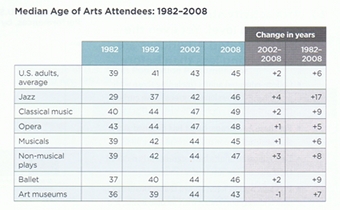
Let me share three tables from the survey. The first looks at the average age of attendees at cultural events. The numbers show that the audience for all types of activities is aging, but the change in the jazz audience is so drastic, that one can scarcely believe what the numbers say. According to the survey, the average age of a jazz event attendee in 1982 was 29, but in 2008 the average age was 46. As hard as it is to believe, the age of the typical jazz fan has increased by seventeen years in just two-and-a-half decades.
The most likely—indeed the only plausible—explanation for these numbers is that very few new fans have discovered jazz since the 1980s. The old fans continue to follow the music, but teenagers and twenty-somethings have very little interest in jazz.
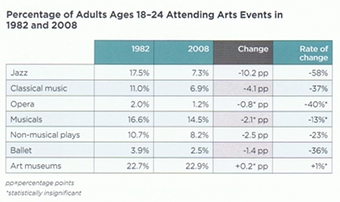
A second chart supports this view. It looks at cultural event attendance for people between the ages of 18 and 24. Except for art museums, all other categories show a decline, but the drop in jazz attendance is enormous—a 58% shrinkage since 1982. The conclusion is indisputable. Jazz has lost most of its younger audience.
This is all the more unsettling, when one considers how much jazz education has expanded during the last two decades. When I was in college, jazz studies hardly existed. African-American music of all sorts was kept out of the curriculum. I still recall the chilly response I received when I played Scott Joplin's "Maple Leaf Rag" for my freshman piano audition. (The requirement was to play a movement from a Beethoven sonata, or something of the equivalent level of difficulty.) Yet jazz was very popular with the students, even if it rarely showed up in a classroom. Nowadays, jazz is accepted at virtually every institution of higher learning. Yet, judging by the NEA study, the students don't have the same level of interest as they did back when it was excluded.
I recently shared in this column my view that jazz was in a state of crisis. Certainly the NEA study only confirms the worst possible interpretation of recent events. Many of us would like to believe that the current collapse in many long-standing jazz institutions is simply a temporary situation, driven by the overall economic malaise. The NEA study suggests that a more chronic problem exists, and that even a reversal in employment figures and home prices won't be enough to prop up the dwindling jazz audience.
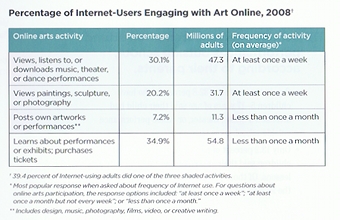
If there is one positive sign from the NEA study, it comes from the figures on the online audience for music. Close to fifty million Americans have some exposure to music via the Internet each week.
This could be a pathway toward expanding the audience for jazz and other performance genres. But the current attitude in the music business, which tends to view the web as the enemy, is not a promising foundation for building on this platform. For the time being, the industry is using every tool at its disposal—litigation, lobbying, technology, bullying—to slow down the growth of a web-based audience.
Maybe if they play hardball long enough, they will force people to give up on MP3 files and go back to the jazz clubs. But the evidence of this study suggests otherwise.
Only the summary findings of the NEA study have been made public so far. It will be interesting to see what the full results will show.
This blog entry posted by Ted Gioia
Tags:

I think it's hardly surprising, given the kind of music boys and girls are listening to in their formative years. It's a sea change in listening habits, due to the incorporation of music within a multitasking environment, where the idea of staying relatively still and silent on a chair while focusing on one thing only is totally foreign to them.
I see this in class - they instantly start fiddling with telephones and other gadgets, thinking they can listen to music while texting or whatever. Sadly, too many musicians - even great musicians - involved in jazz education do not push enough their students to listen to jazz. In fact, if they could take time off the teaching - sometimes difficult due to pressure from their institutions - and ask to their students what they are actually listening to, or just gently detach earphones and check first-hand, they could better understand what is going on. The listening habits of the young people coming to "jazz education" are the same, or almost the same, as their age class, and sadly many of them do not listen to "jazz" at all, or very little, even before releasing their own Cds.
I can quote countless cases - the piano player who played "Take The A Train" at audition but never heard Duke's rendition (he was contracting into a Keith Jarrett imitation clawhand even before playing one note), the amazement of piano students LISTENING to "Straight No Chaser" and realizing that the realbook has a version "for dummies", or the group playing Horace Silver pieces without having ever heard them on records. In many of these cases, "teachers" taught these compositions without ever going back to their performance history.
This might seems innocuous, but is in fact the interruption of the "oral" transmission line, which was since long granted by recordings. If this connection is severed, the young students do not even think, or need, to actually listen to the music, on records or live. And believe me, if you present the music in its time and its classic recordings as live and contemporary they love them. Of course, if you just go and tell them "Listen to all the Hot Five and Seven recordings" they download the box and promptly forget them after trying to listen once - it's like telling somebody to go and read Iliad in original without knowing Greek. But if you paint them the blind singer on an Aegean island scaring the shit off his listeners with tales of blood and fight, and then making them cry with romance, they do listen...as they listen to Weatherbird and Black Bottom Stomp in the proper condition, and are moved even to clap their hands in enthousiasm.
I recently tried to discuss some key points of jazz history with young musicians (no names) and they never heard of Duke Ellington's Ko Ko; a student writing a thesis on it was "listening" to a lousy 128 Kbps mp3 file of it GIVEN BY THE TEACHER and was shocked to hear it on loudspeakers properly played. Digital promised us perfect sound forever and gave us forever degrading sound, but this is another (not unrelated) subject.
Mind you, this is exactly what is happening with classical musical education, where teachers and students simply do not go to listen to live music (I am talking about classical and opera) so that schools are giving credits for going to concerts, which I thought very odd: if you have a passion for music pushing you to make it your profession, you should be hungry for concerts, but apparently this is not the case. So let us all do whatever we can to avoid jazz education mirroring the defects of classical music teaching.
My two (Euro) cents' worth...