The Jazz.com Blog
August 10, 2009 · 0 comments
100,000 Fans Flock to Small Town Jazz Festival (Hint: Not in the US)
In a series of articles in this column, Stuart Nicholson has reported on various European festivals that attract a large, young audience that few US jazz events can approach—and without watering down the jazz content, as has become almost de rigueur in the States. Is there something the Yanks can learn from these examples? Now Nicholson journeys to Molde in Norway, where 100,000 people come to a city with a population of only 25,000, to hear the music. T.G.
In the 1960s and early 1970s, the jam sessions at the Molde Jazz Festival were the stuff of legend. At around midnight when the festival concerts had finished, musicians and a small number of fans and festival volunteers drove up to Varden, a small café in the mountains overlooking Molde town, where sessions lasted until dawn.
“When I first came to the festival in 1971/1972 young enthusiasts were able to sneak in there,” says Jan Ole Otnaes, who is now the Festival Director. “In 1972 I heard Keith Jarrett on drums, Miroslav Vitous on bass, Zawinul on acoustic piano, Berndt Rosengren, the Swedish saxophonist, and Wayne Shorter. People still talk about one memorable night when Sonny Stitt and Dexter Gordon battled it out until daybreak. Everyone who experienced that still talks about it! Another was in ’65 when Jan Garbarek sat in with local musicians. I’d love to have heard that as he was just seventeen years old and they say he was an amazing player even then!”

Situated on the West Coast of Norway, Molde has been host to Norway’s largest jazz festival for almost fifty years. It is one of the longest running festivals in Europe and is set in an area of outstanding natural beauty that includes the highest waterfall and highest sheer mountain face in Europe. Molde itself has a population of some 25,000 people and during the festival week attracts an incredible 100,000 visitors. “All the big names in jazz have played here—Dizzy, Miles, Ornette, Oscar Peterson, Herbie Hancock, Keith Jarrett, Chick Corea, Pat Metheny,” continues Otnaes, “In 1989 we started to do outdoor concerts presenting artists like Steely Dan, Eric Clapton, Van Morrison, Bob Dylan, Erykah Badu, Loren Hill, Sting, Elvis Costello, Mary J Bligh, Allen Toussaint, there’s been a bunch of big names.”
The festival headliners, this year including Jamie Cullum and Leonard Cohen, appear on an outdoor stage nestling in the natural contours of the mountainside above the town, with each concert attracting over 10,000 fans. The remaining concerts were held at venues around the town, and it was striking that at every venue, including the outdoor stage, the sound and lighting were of a very high standard.
This year’s Artist in Residence was trumpeter Arve Henriksen, who is on course to become one of Europe’s major jazz attractions. He seemed to be everywhere, from performing a major concert each day of the festival to patiently working with children at the daily kid’s music workshop. He had begun his concert series on Monday with a performance of music from Cartography, his recent debut album on the ECM label, but I was there for the final three days of the event, catching his Thursday night performance with the group Supersilent. The band was formed several years ago when Henrikesen, Ståle Storlokken on keyboards and Helge Sten on guitar were jazz students at the Trondheim music conservatory, and their work is documented by Oslo’s ultra hip Rune Grammofon label.
Now its a trio following the recent departure of drummer Jarle Vespestad, with everybody doubling on electronics, and Henriksen also doubling on drums from time to time. As the textures of their music ebbed and flowed, there was a moment when, hunched over their laptops, they seemed like telephone operators fielding other-worldly ringtones from distant planets. Yet Supersilent’s spontaneously conceived music forced you to leave a world with which you are familiar and immerse yourself in their alternative musical universe, which frequently coalesced around moments of true organic creativity before dissolving into wrong-end-of-the-telescope images of Bitches Brew or the Zawinul Syndicate. Despite often implicit rhythms from Henriksen’s drums, the trio version of the band seemed lighter on their feet and able to respond to each other’s creative impulses in a way that suggested a fresh new chapter in their development was beginning.
Mathias Eick, also an ECM recording artist and trumpet player, has quite a different take on his instrument to Henriksen. He prefers a more orthodox rhythm section, but his music seems to progress in a series of sighs. This is not urban, big city music but music of space and rural chastity. Eick’s tone and approach is distinctive, yet he is not one to force his sound on you, rather gradually envelop your senses with the pervasive, story-telling logic of his solos.
Huntsville were another band not given to grand gestures, despite the abstract disposition of their music. Comprising Ivar Grydeland on guitars and banjo, Tony Kluften bass and percussion and Ingar Zach drums and percussion, they use conventional instruments in unconventional ways. Their less-is-more ethos combined with an ability to shape drones, mysterious sound textures, ambient washes and spontaneous interaction into a cohesive musical identity. The result was a music that achieves its end through a series of modest surprises and understatement.
There was nothing understated about accordionist Richard Galliano and pianist Gonzalo Rubalcaba, doing their rounds of the European circuit. Their music spoke from an age now passing in jazz when virtuoso technique was admired as a thing in itself. Notes were scattered like confetti, raining down on a contended audience but as with all mass production techniques, something is often lost in the manufacturing process.
Daniel Herskedal, who is from Molde, and his ensemble Some City Stories presented a series of programmatic postcards inspired by cities around the globe. A tuba player, conceptualist, composer and arranger, Herskedal is a musician to watch. He exploited the tonal resources of his small ensemble (trumpet, saxophone and electronics, guitar, drums and tuba) by using every possible permutation of instrumentation—and then some. Saxophonist Sissel Vera Petterson turned out to have a beautiful soprano voice, while trumpeter Per Jorgensen responded with a remarkable falsetto contralto. Herskedal’s used these unusual tonal resources in surprisingly original ways, and with Terje Isungset’s ability to colour the music with a remarkable range of percussive effects (the Ice Man has indeed cometh), the result was music of rare originality, substance and depth.
Another memorable set came from one of Holland’s finest ensembles, Bik Bent Braam’s big band, which presented a set that deservedly had the audience on their feet demanding more. Their range, by contemporary standards, is remarkable, signifying on every era of jazz without condescension or incongruity. Traditional big band fare of antiphonal riffs dissolved into sandstorms of amplified huffs and puffs through their instruments, then, as if guided by some unseen hand, a powerful blues episode rose up and climaxed in a spectacular cascade of splintered motifs. Through it all, the inscrutable figure of Braam sat at the piano, immaculately groomed and a study in nonchalance. His most extravagant gesture during the whole performance was to sip a mouthful of water from a plastic bottle. With moments of Willem Breuker-inspired humour it was wonderful theatre. The late Spike Milligan, a devoted jazz fan and arch humorist, would have loved it.
On Saturday, Marilyn Crispell performed an eloquent solo set that was at times pensive and often percussive while tenor saxophonist Tony Malaby’s time-no-changes set with Double Heart was an edgy affair. Malaby has a fine tone on saxophone, but the open-ended forms tempted him to travel too far with his solos, so they wilted towards the end.
Like the amp in Spinal Tap that was turned up to eleven, The Crimetime Orchestra, comprising some of Norway’s finest young musicians, brought to mind Nigel’s comments to Marty in the film, “You see, most blokes will be playing at 10. You’re on 10, all the way up. . . Where can you go from there? Where? Nowhere. What we do if we need that extra push is…eleven. One louder.”
The main talking point on Saturday was the return of Jaga Jazzist. Now it’s probably fair to say that many outside Scandinavia never knew they went away in the first place, but in their original incarnation in the early 2000s, this band had audiences queuing around city blocks to see them. Pulling together jazz improvisation, electronica and the rhythms of jazz and rock, their debut 12 inch single “Going Down” was earmarked as a key single of 2002. It was followed by two CDs, Living Room Hush and The Stix, using brass, woodwinds, vibes, Stereolab-style keyboards, bass and guitar mediated by Martin Horntveth’s power drumming.
Horntveth, his brother Lars, and sister Line are the heart of the band, around whom the ensemble was built. Complex arrangements with shifting textures demanded almost everyone in the band double on several instruments. Lars, for example, plays tenor, soprano, bass clarinet (giving the band its distinctive sound signature), guitar and keyboards; while his sister Line plays tuba, flute, percussion, melodica and adds wordless vocals. Their sets could last some ninety minutes without a pause for breath or a piece of sheet music in sight. At their best they seemed as if they could move mountains and suddenly they were gone.
A comeback is usually a fraught affair and like the film of the book, is never quite how you remembered it. But approaching the Bjornsonhuset Konsert complex, the portents looked good. The long queues of young, expectant fans were back and Jaga Jazzist did not disappoint them. No longer one uninterrupted set, the individual compositions (some new some old) were introduced by the eldest of the three siblings, drummer Martin and what emerged was a much tighter fusion between contemporary rock rhythms and jazz producing a refreshingly contemporary take on good old jazz-rock. Trumpet solos were by Mathias Eick, demonstrating a range that took him from the thoughtful, moody disposition of his own music to the exuberant energy and vitality projected by Jaga Jazzist. It was a powerful musical experience and the young crowd, some 5,000 strong, loved it.
In contrast was Arve Henriksen’s final concert of the festival at the Molde Domkirke, a beautiful modern church in the town’s centre. Combining with Trio Mediaeval, keyboard player Ståle Storløkken and DJ Jan Bang, Henriksen’s singing trumpet tone provided the link between the three part harmonies from Mediaeval times and the futuristic ambient sound washes from Bang and Stroløken. This haunting, captivating, non-genre specific music underlined what an important—and accomplished—musician Henriksen has now become.
Nicola Conte, the Italian DJ, conceptualist, composer, lyricist and guitarist has a passionate love of jazz which he wants to share with younger audiences. He believes they are all jazz lovers at heart, if (i) they only knew it, (ii) could hear jazz in a world dominated by popular culture and, (iii) could dance to it. His midnight concert winding up the festival provided a chance to test his theories. He mixed his own originals with his well crafted lyrics (he subtly makes and original like “Karma Flower” an anti-war protest) sung by the talented Veronika Harcsa from Hungary with sprightly jazz originals by European jazz musicians, such as Dusko Gojkovic’s “Macedonia,” and it was fascinating to watch his all-standing audience of 18 to 30 year-olds gradually begin moving in time to the music—and finally start dancing to it. The key was a combination of infectious Brazilian beats and top notch jazz soloing from Pietro Lussu of Italy on acoustic piano and Timo Lassy from Finland on tenor saxophone. Yes, this music was accessible but it was also swinging and had an integrity that young audiences responded to. Neither cop-out or sell-out—Lussu on piano and Lassy on tenor saw to that with several powerful solo statements—it represented one man’s crusade to bring jazz to the one constituency that is fast beginning to desert it: younger audiences.
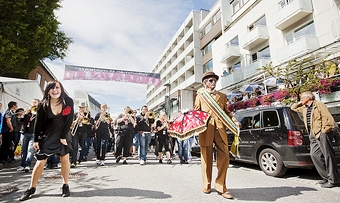
Yet Conte’s late night concert was framed within the context of a festival that equally sets out to do draw younger audiences into jazz. Its wide ranging program embraced every style, from New Orleans through to jazz of the future. Audiences buy a festival pass and are encouraged to go from venue to venue and discover the music for themselves. With year round outreach programs into local schools and a parade at 11AM each morning of the festival by school kids, it came as no surprise to see so many young faces in the audience, especially when almost a thousand enthusiastic young volunteers work for the festival in exchange for free concert tickets.
Without a doubt jazz in Molde has become firmly embedded in the community. Where else will you find a free dawn concert on the open hillside attracting an audience of over 1,500 people, many of whom had brought breakfast picnics to enjoy the event. Called “Break of Day in Molde” after a song recorded by vocalist Karin Krog, who was inspired to write the lyrics after emerging from an all night jam session at Varden in the early 1970s, this year’s event was given by Arve Henriksen who seemed as taken by the concept as the audience.
With the sun rising over the 222 mountain peaks, many still snow-capped in July, that surround Molde (somebody from the Tourist Board with time on their hands actually counted) it was impossible not to reflect how far jazz had travelled from its origins in the bordellos and speakeasies of early 20th century America. It really is a remarkable music, here celebrated by a remarkable festival.
Check back soon for an upcoming blog “An Anatomy of a Jazz Festival,” an interview with Jan Ole Otneas, Festival Director of the Molde Jazz Festival, who talks about the mechanics of running one of Europe’s oldest and most successful jazz festivals.
This blog entry posted by Stuart Nicholson
Tags:

Comments are closed.