The Jazz.com Blog
August 17, 2009 · 0 comments
Blues Notes from All Over
Even if you haven’t heard of Jim Dickinson, who passed away on Saturday at age 67, you have heard him. If you’ve ever listened to the Rolling Stones’ “Wild Horses” or Arlo Guthrie’s “City of New Orleans” or various other tracks by Bob Dylan, Johnny Cash, Aretha Franklin, Carmen McRae, Ry Cooder, and a long list of other stars, you have enjoyed his supple, bluesy piano work. Dickinson was also deeply immersed in the musical traditions of Memphis and North Mississippi, and was the closest thing you will ever find to a walking, talking history lesson in those parts of the country.

I ran into Dickinson a few months back when I was invited to talk and play piano on the Thacker Mountain Radio broadcast out of Oxford, Mississippi. I was happy to oblige the request to perform some blues music on the airwaves—until I learned that I would be replacing Jim (the house pianist) on the keys. I thought it was sacrilege for me to fill in for this much-larger-than-local legend. But Dickinson was friendly and obliging, and I ended up playing some music and also having the chance to meet this fascinating individual whose work I had long admired.
I also spent much of that evening seated next to his wife Mary. But she was more interested in talking about her children than about her husband. And who can blame her? Their sons Luther and Cody Dickinson are famous in their own right. The “kids’ band,” the North Mississippi Allstars, is as fine an electric blues band as you will hear anywhere these days, and this group has enjoyed a well-deserved crossover success with many young fans who have little or no previous exposure to blues music. Moreover, Luther Dickinson’s recent decision to join on with the Black Crowes gives him access to a larger audience than any blues musician can dream about—that band has sold more than 20 million records.
So Mom (and Dad) had good reason to be proud.
When I met Jim Dickinson, he was working on his autobiography. I’m not sure how far along he got. But what a story—or rather a collection of stories—that would be. Jim knew all the old Memphis blues pioneers back in the day, and then later shared the bandstand with a veritable who’s who of blues and rock. He will be missed, and can't be replaced.
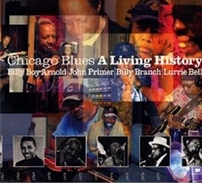
Blues musicians often can’t decide whether they want to celebrate the past or charge into the future. Sometimes they try to do both at the same time—and end up failing at both.
Yet a new double CD, Chicago Blues: A Living History shows how it is supposed to be done. The 21 songs featured here are proven classics, and the comprehensive and smartly-done liner notes will tell you why they are so important. But the versions on the CD are new ones, performed by a top notch cast. The personnel changes from track to track, but includes Billy Boy Arnold (whose recent Billy Boy Sings Sonny Boy made my list of the best blues CDs of 2008), John Primer, Billy Branch and Lurrie Bell.
This is deep blues indeed. Primer learned his craft under the mentorship of Muddy Waters and Willie Dixon, and shows here how deeply he immersed himself in the Chicago tradition. Billy Boy Arnold, for his part, got his first harmonica lesson at age twelve from Sonny Boy Williamson, and later gigged with Bo Diddley. The rest of the cast is excellent, and the end result is a lock for this year’s list of best blues releases.
A track from this CD is featured as the current Song of the Day at jazz.com.
I enjoy the music of that great poet of early Mississippi blues, Skip James—even when a moose is doing the lip-synching.
When I want to know what a puzzling blues lyric means, I go to my friend Stephen Calt. He wrote a guide to the “idioms of Robert Johnson” years ago that has proven invaluable to researchers in the field as well as casual fans—Calt helps the uninitiated understand those odds phrases such as “I’ll do the Breakaway on your liver” or “I woke up this mornin’, my biscuit roller was gone.”

These blues lyrics can be surprisingly complex. I sometimes feel that it would be easier to unravel the significations of "A" by Louis Zukofsky than determine the meaning of some of these old tunes. Great progress has been made in the field—some years back it was hard enough to figure out what syllables were being sung on many of these 78s, let alone what the words meant—but there are still numerous areas of disagreement, contention and sheer puzzlement.
When researching my book Delta Blues, I learned that Calt had done extensive research for a comprehensive dictionary of blues terminology—a project he had started decades ago, but had put aside unfinished. I prodded and encouraged him to return to this work, and even offered to help out myself if need be. From what I saw of his research, it was far more detailed than any of the other works out there. Indeed, it was so far ahead of them, that there really wasn’t any comparison. I can’t tell you how gratified I was when I learned that he decided to finish the book.
As it turned out, my help was not necessary here, and Calt on his own has completed an impressive guide, one that is every bit as good as I had hoped. Finally we have our Rosetta Stone, a single source that unlocks the meaning of these great old blues. This author not only knows the blues field inside and out—Calt is author of excellent biographies of Charlie Patton and Skip James and has met and interviewed many important blues artists who are no longer with us—but he also has dug deeply into language-related research material few blues writers even know about it. This gives him a rare, if not unique ability, to unravel the arcane significations of the past blues masters. He shows historical antecedents to these phrases that will surprise the experts, but also writes this guide with enough panache that even casual fans will enjoy it.
The book, entitled Barrelhouse Words: A Blues Dialect Dictionary, won’t be out for several more weeks. But can be pre-ordered here. Check it out . . . but don’t mess with my biscuit roller!
This blog entry posted by Ted Gioia
Tags:

Comments are closed.