The Jazz.com Blog
August 18, 2009 · 0 comments
A Fitting Epitaph to Mingus's Big Score
When jazz fans discuss the really big compositions of the past, a small number of controversial classics dominate the conversation: including Ellington's Black, Brown & Beige, Marsalis's Blood on the Fields, and Mingus's Epitaph. A new video gives Thomas Cunniffe the opportunity to revisit the latter work, and consider whether it was an ambitious failure or the culmination of the composer's career. T.G.
A critic once asked Duke Ellington if his music had influenced Charles Mingus. Ellington replied, Well, that what he says. Perhaps the source of Ellingtons myopia was a simple case of presentation. Both men fought deadlines to have music ready for performances, but Ellington could make any piece sound complete, even if he had further revisions in mind. Mingus wasnt always able to create that illusion. While Ellingtons recorded legacy sounds like one polished masterpiece after another, Mingus discography is littered with musical experiments that were not fully thought-out and never properly realized. Of course, Mingus had plenty of musical projects that were total successes, but for every Charles Mingus Presents Charles Mingus or East Coasting, there was a disaster like the 1962 Town Hall concert.
The Town Hall concert seemed doomed from the start. Someone should have known that moving up the date of a live recording by 5 weeks would be a major problem, especially when the project involved 30 musicians and a program of newly-arranged music. Mingus should have insisted on a postponement, but instead he tried to meet an impossible deadline. By the time of the concert, he had hired a team of arrangers and an entire firm of copyists (some of the copyists were onstage writing parts as the concert went on!). Minguss overwhelming stress led to an argument with Jimmy Knepper. Mingus punched the trombonist in the jaw, causing major damage to Kneppers embouchure. Knepper was unable to play the concert as scheduled, and he sued Mingus for assault.
On the night of the concert Mingus apologized to the audience, telling them that what would follow would be an open recording session. Since the event had been advertised as a regular concert, Mingus encouraged the audience to ask for their money back. Overall, the music was sloppily played. While there were a few musical highpoints (including brilliant solos by alto men Eric Dolphy, Charles McPherson and Charlie Mariano), there was no sense of completeness, as Mingus usually cut pieces off before the end.
The United Artists LP of the concert was poorly engineered, and several of the compositions were mistitled and shortened. If Minguss intention was to assemble the parts in the editing room, he never got the opportunity. Alan Douglas, who produced the recording, was fired by UA shortly after the concert, and George Wein, with whom Mingus had had words with during the concert, was put in charge of the editing. In 1994, Brian Priestly assembled all of the surviving concert tapes, which were remastered and restored by Blue Note. The results were issued as The Complete Town Hall Concert. Unfortunately, the music was still a mess. While the CD sound was much better than the LP, the original balance problems could not be fixed (the original recording engineers were not able to see the concert as it was recorded, and with no monitor speakers onstage, the musicians couldnt hear each other.) Worse yet, there were not sufficient directions left over from the session to create some semblance of Mingus musical intentions.
Of course, its hard to say just what those intentions were. Did Mingus want to create some sort of career retrospective? After all, the program included pieces from various parts of his career. But would United Artists have agreed to a multi-LP set of a mammoth concert (assuming, of course, that there could have been a fully-prepared concert instead of an open recording session)? Several of Mingus biographers note that he came back to this music after the concert, adding more pieces to create the suite Epitaph. Perhaps Mingus was hoping for a second chance for this music. That didnt happen until ten years after his death.
In 1985, while cataloguing all of Mingus written music, musicologist Andrew Homzy discovered the Epitaph score. As might be expected, it was not a complete score: several pieces were missing endings, there was no definitive finale for the work, and one piece had to be literally cut and pasted together to make a performing edition. However, it was clear from the instrumentation that the work was Mingus post-concert suite. Gunther Schuller edited the work and on June 3, 1989, the final work was premiered by an all-star group (with Schuller conducting) at Alice Tully Hall in New York. The concert was videotaped for Britains Channel 4, and the audio from the tapes were used for Columbias 2-CD issue of the concert. After 20 years, the video has finally been released on DVD by Eagle Eye Media.
While the complete recordings of the Town Hall concert would not be issued for another five years after the Epitaph concert, Schuller did an admirable job in transforming the fragmented piece into a unified whole. Where the endings were missing, he segued into another piece (Mingus left some instructions of this sort in the score) or created a new ending in Mingus style. The band featured several Mingus veterans, including George Adams, Jack Walrath, Britt Woodman, Eddie Bert, Paul Faulise, Snooky Young, Don Butterfield, John Handy and Jerome Richardson (Woodman, Bert, Faulise, Young, Butterfield and Richardson all played at the Town Hall concert).
The music sounds like classic big band Mingus andwhether the composer meant it or notit acts as a career retrospective. Theres a 1939 Mingus composition called Chill Of Death that was originally conceived as a classical piece, a re-working of his arrangement of Body and Soul originally made for the Lionel Hampton orchestra, an atonal mambo, remakes of classic Mingus works like Peggys Blue Skylight and Pithecanthropus Erectus and even an arrangement of Jelly Roll Mortons Wolverine Blues (featuring a jazz bassoon solo!). However, its also a lot of extremely dense music packed into a little over 2 hours. The barn-burning small group version of Better Git Hit In Your Soul offers needed contrast, and its a shame that more of that side of Mingus music is absent from this concert.
The video production is clean and understated, but the camera crew missed shots of several soloists, and the video fails to show multiple images when several levels of music occur simultaneously. The DVD has no extras, and while the booklet includes the CD liner notes by Schuller, they are not the complete notes, but a severely truncated version. I can understand cutting the notes because of printing costs, but still frames take very little space on a DVD, and all of Schullers notes plus a biography of Mingus could have been included as extras.
CHARLES MINGUS: THE COMPLETE TOWN HALL CONCERT Blue Note CD 28353. Original recording produced by Alan Douglas & George Wein. Reissue produced by Brian Preistley. Clark Terry, Ernie Royal, Snooky Young, Richard Williams, Rolf Ericson, Ed Armour, Lonnie Hillyer (trumpets); Britt Woodman, Quentin Jackson, Willie Dennis, Eddie Bert, Jimmy Cleveland, Paul Faulise (trombones); Don Butterfield (tuba); Romeo Penque, Eric Dolphy, Charlie Mariano, Charles McPherson, Buddy Collette, Zoot Sims, George Berg, Pepper Adams, Jerome Richardson, Danny Bank (reeds); Warren Smith (vibes, percussion); Toshiko Akiyoshi, Jaki Byard (piano); Les Spann (guitar); Charles Mingus (bass, vocal); Milt Hinton (bass); Dannie Richmond (drums); Grady Tate (percussion). New York (Town Hall); October 12, 1962.
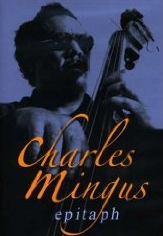
CHARLES MINGUS: EPITAPH Eagle Eye DVD 39171-9/Columbia CD 45428. Directed for video by Humphrey Burton. Produced for television by David Woolf. Concert produced by Sue Mingus. Randy Brecker, Wynton Marsalis, Lew Soloff, Jack Walrath, Joe Wilder, Snooky Young (trumpets); Eddie Bert, Sam Burtis, Paul Faulise, Urbie Green, David Taylor, Britt Woodman (trombones); Don Butterfield (tuba); John Handy, Jerome Richardson, Bobby Watson, George Adams, Phil Bodner, Roger Rosenberg, Gary Smulyan, Michael Rabinowitz, Dale Kleps (reeds); Karl Berger (vibes, percussion); Roland Hanna, John Hicks (piano); John Abercrombie (guitar); Reggie Johnson, Edwin Schuller (bass); Victor Lewis (drums); Daniel Druckman (percussion); Gunther Schuller (conductor). New York (Alice Tully Hall); June 3, 1989.
This blog entry posted by Thomas Cunniffe
Tags:

Comments are closed.