The Jazz.com Blog
August 02, 2009 · 0 comments
Remembering Don Ellis (Part 1)
On any short list of exciting, innovative bandleaders of the 1960s, Don Ellis deserves a prominent spot. Yet fans today seldom encounter the name of this visionary artist who combined odd time meters, world music, electronics, microtonalismand any other new and exciting effect he could findinto hot, swinging big band performances. Youve heard of extreme sports? Well, how about some extreme music. Jeff Sultanof tells us why we should remember Don Ellis below, in the first installment of a two-part article. T.G.
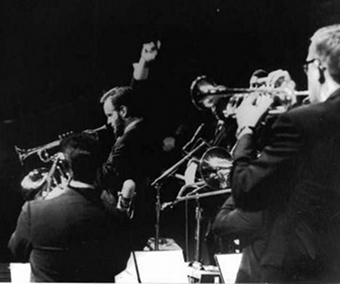
Don Ellis had one of the finest big bands in the history of the ensemble, and his was one of the most popular groups in the late sixties-early seventies. He was a composer who knew no limits; his music incorporated concert music, jazz of all eras, rock, unusual time signatures, electronics, Brazilian and Indian music.
But today with his albums reissued, he is almost entirely forgotten except by the faithful. So when it was announced some years ago that filmmaker John Visuzzi was raising the money to make a documentary on Ellisnow released as Electric Heart: Don EllisThe Man, His Times, His Musicwe who love music applauded and gave him moral support.
Ellis fans hoped that this would be a major statement about a musician who extended the vocabulary of twentieth century music, and who left an unforgettable mark on all of us who experienced his message.
Oh, well! And yet if you are a fan of big bands and eclectic musicians, this should be in your library.
Visuzzi had the help of the Ellis estate. He interviewed key players in the story: Maynard Ferguson (whod hired Ellis for his own band) and important contributors to the Ellis ensemble such as Fred Selden, Milcho Leviev, and Sam Falzone. He interviewed people who had a little bit to do with Ellis, such as Gunther Schuller. He interviews someone named Emilie Robertson whom we discover in the DVD extras was Elliss lady in his later years.
Who was Don Ellis? Was he truly equal to the hyperbole used in the documentary?
Yes, he was, and he deserves a full discussion in this article. He was one of my heroes when I was a music student and continues to inspire me and many others for whom music has no limits.
Ellis was born in 1934. Originally he wanted to play the trombone, but was instead given a trumpet by his pastor father. He became a true virtuoso on the instrument and wrote music as well during his teen years. He studied at Boston Conservatory where he received a thorough music education, studying composition with Klaus George Roy and orchestration with Gardner Read.
Around the corner from his apartment was the Schillinger House (later called the Berklee School of Music) where Ellis would jam with the jazz players of the day who came up to Boston for gigs and to have jam sessions with the jazz students. Ellis played for such leaders as Claude Thornhill, Woody Herman, Sam Donahue, Charlie Barnet, Lionel Hampton, Maynard Ferguson and even the Glenn Miller Orchestra directed by Ray McKinley. By the early sixties, he had played with Charles Mingus and George Russell (his stints with both modern composer/artists are not mentioned in this documentary, a shocking omission).
Having experienced what was considered the jazz avant-garde and finding it lacking, he became interested in other sources of music. By the mid-sixties, he was taking ethnomusicology courses at UCLA and studying privately with Hari Har Rao, one of Ravi Shankars students. Rao opened up an entire world of rhythmic patterns and permutations in Indian music, and taught him how to develop new patterns. Because some of these patterns and time signatures were also used in Greek and Turkish music, Ellis became a world music artist before the category was coined.
As if this wasnt challenge enough, he went to the Holton Company and asked them to design a trumpet that could play quarter tones (briefly, music has evolved into a language of whole and half steps. Evans wanted to play a trumpet that could play in-between the half steps, which has rarely been done in Western music). This of course took Ellis to new discoveries in musical pitch and harmony, and he became a master at using these new sounds. His own improvisational style ran the gamut: from Dixieland through the most modern musical utterances.
Ellis started a rehearsal band to perform his compositions in unusual time signatures. The musicians found this music very hard to play, but Ellis was patient with them, and they soon became very adept at playing these unique, swinging pieces Ellis brought to each rehearsal. The band had a regular Monday night gig at a Hollywood club named Bonesville, and word began to spread about this new band. Stan Kenton was a member of the audience at times, invited by Ellis trumpeter Glenn Stuart who also played for Kenton.
This blog entry by Jeff Sultanof is the first installment of two-part article on Don Ellis. For part two of this article, click here.
Tags:

Comments are closed.