The Jazz.com Blog
August 22, 2009 · 0 comments
Why Lester Young Matters
Lester Young, whose 100th birthday will be celebrated on Thursday, exerted far more influence on later generations than most jazz fans realize. They don't appreciate his significance because—unlike, say, Coltrane's or Mingus's—it often loomed largest outside of the jazz world.

The cool aesthetic that Young defined in the 1930s and 1940s was much more than a jazz movement. As I show in my forthcoming book The Birth (and Death) of the Cool, it eventually came to permeate the broader contemporary culture. In time, the cool worldview shaped how average Americans dressed and acted and spoke—often borrowing hipster phrases originated by Young himself. In fact, we have good reason to believe the very meaning of the word 'cool'—in its modern signification of a fashionable hipness—originated with this unconventional saxophonist.
Lifestyle choices and behavior patterns that started with Young and a small number of jazz cats, became the de facto way of life for the 1960s generation. This strange process, which I outline in my book, is all the more surprising when one considers how unusual Young was in the context of his own generation. During his military service, Young was diagnosed as "a constitutional psychopath" and branded as a misfit due to his "drug addiction (marijuana, barbiturates), alcoholism and nomadism." Because of his effeminate ways, Young was sometimes thought to be a homosexual—today he would be typecast as a "metrosexual" and it would probably enhance his music career, but in the context of the 1930s jazz world, Young was an outlier . . . both in this regard and on any other bell curve you might care to chart.
Oddly enough, almost all of his eccentricities—linguistic, behavioral, psychological—became part of the American way of life in the years following his death. This is the secret history of "the cool": it was the process by which people in Middle America started acting like jazz musicians. And no musician of his generation set the tone for this future development more completely than Lester Willis Young.
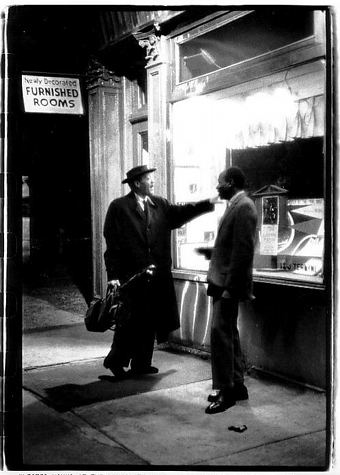
In other words, Lester Young was a sociological force as well as a musical one.
But even in the realm of music, Young's influence was far greater than even his fans realize. This is because Young's approach was perfectly suited for assimilation by those outside the jazz scene. If you were a pop arranger or soundtrack composer, you could borrow from Young in a way that you could hardly do from Bird or Trane. His lithe, melodic approach with its understated sense of rhythm—less syncopated than Louis Armstrong's, less wedded to the downbeat than Coleman Hawkins's—could be applied in almost any musical setting. His way of phrasing and choice of notes, less chromatic than Charlie Parker's and more reliant on color tones (especially sixths and ninths), was suitable for both jazz and other commercial styles. In short, Young's approach was more flexible than any of his peers' during 1930s and 1940s, and the easiest to adapt to new uses.
Where do we find the impact of Young's aesthetic vision (as opposed to his behavior patterns and mannerisms) during the second half of the 20th century? In this regard, too, Prez is encountered almost everywhere. His influential style played a prominent role in the West Coast movement of the 1950s. It was studied by Tristano and Konitz and other representatives of the East Coast cool school. It was transferred to the big band in the form of the "Four Brothers" sound of the Woody Herman band. It was assimilated by Brazilian music around the time of Young's death in 1959, and helped shape the bossa nova style.
Whenever you hear a sax behind a pop singer you are hearing echoes of Young's seminal body of work accompanying Billie Holiday. When a classical music piece requires a saxophonist, odds are the sound will be closer to Young than to Coltrane or Rollins or Brecker. Even elevator music shows Young's stamp. Almost every sax player on those Muzak charts is pursuing an ideal sound that comes from Lester as refracted through Stan Getz (the most famous of Young's followers).
In other words, jazz fans have a hard time measuring Lester Young's influence because it has traveled so far and spread so widely. Yet I sometimes fear that Lester Young, for all his importance, is one of those grand figures from the past who has fallen off the radar screen of today's jazz listeners. As I have described elsewhere, music consumers of the new millennium have little patience with the poor sound quality on those old recordings. And almost all of Young's greatest recordings date from the pre-hi-fidelity era. No matter how much the engineers clean them up, they still sound like what they are . . . old records.
As a result, modern-day fans are more likely to know Charles Mingus's tribute to Lester Young ("Goodbye Pork Pie Hat") or even Joni Mitchell's tribute to Mingus's song than to have heard those great Young Kansas City Six recordings or Prez's solo on "Lady Be Good" (which was once memorized by aspiring saxophonists).
So a hundredth birthday is a good time to celebrate the life and times of Lester Young. But it is also a perfect opportunity for those who haven't heard this artist's finest works to seek them out. (Michael J. West's article here is an excellent starting point.) Whether people know it or not, they have been listening to imitators of Lester Young all their life. Now they ought to check out the real thing.
This blog entry posted by Ted Gioia
Tags:

Comments are closed.