The Jazz.com Blog
August 25, 2009 · 0 comments
Feinstein's Opens Its Doors to Jazz
Eugene Marlow, a regular contributor to this column who recently wrote about vocalist Malika Zarra, now turns his attention to the DIVA Jazz Trio. The trio's appearance last week at Feinstein's marked a rare move by this cabaret room to embrace more jazz-oriented fare. Marlow fills us in on the details below. T.G.
Feinstein’s at Loews Regency—61st Street on Park Avenue in Manhattan, New York City, in one of the more posh sections of the city—is a plush supper club dedicated to the presentation of the Great American Songbook. Co-established 10 years ago by pianist/singer Michael Feinstein and the Tisch family, Feinstein’s has embarked on an “experiment,” according to John Iachetti, the room’s affable Director of Entertainment: to present straight ahead, mainstream jazz groups in addition to its traditional panoply of Great American Songbook piano/singer duos.

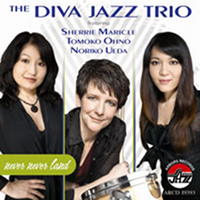
One such group is the DIVA Jazz Trio, featuring drummer Sherrie Maricle, bassist Noriko Ueda, and pianist Tomoko Ohno. The trio performed single sets on two evenings (August 18 & 19) with a rundown of its debut collaboration, a CD (on the Arbors Records label) entitled Never Never Land.
The Feinstein venue was fitting. Numerous cuts on the highly musical, entertaining 10-track album are drawn from classic Broadway shows, films, and television programs, among them: “If I Only Had a Brain” (The Wizard of Oz), “I’ve Grown Accustomed to Her Face” and “I Could Have Danced All Night” (My Fair Lady), “My Favorite Things” (The Sound of Music), “Oh, What a Beautiful Morning” (Oklahoma), and the title track “Never Never Land” ((Peter Pan).
What makes for a compelling and entertaining musical performance? For me a major part of the answer is (1) did the performers transcend their environment, and (2) did they draw the audience into the performance. It is legendary that showman/impresario Florenz Ziegfeld of the early part of the 20th century once remarked to comedian/entertainer Eddie Cantor (when the latter first appeared in the Ziegfeld Follies in 1917) “Make me forget about the beautiful [and scantily clad] girls.” Cantor did. (Following his successful debut, Cantor is alleged to have remarked, “It took me 25 years to become a hit overnight!”)
Feinstein’s is probably one of, if not the plushiest of supper clubrooms in the city. Capable of seating 120-130 patrons, the raised stage is replete with a Steinway Grand, an excellent lighting and sound system, and a soft, lit backdrop. The chairs are comfortable. There’s adequate spacing among the tables. The wait staff is well groomed, knowledgeable, and courteous. The food is well prepared and entertainingly presented. The overall ambiance is enough to keep your attention—as are the prices: $30+ cover charge, for example. This room demands class, the kind of class the DIVA Jazz Trio offered with a performance that made you forget about the “beautiful” surroundings.
Drummer Sherrie Maricle, who served as the trio’s engaging interlocutor, is well known for her participation in the Stanley Kay initiated 16-year-old “Sherrie Maricle and the DIVA Big Band” and more recently the New York Pops. Bassist Noriko Ueda has been the DIVA Big Band bassist for about eight years, but has also performed with Grady Tate and many others. Pianist Tomoko Ohno is also a regular with the DIVA Big Band. The advantage of an intimate group, such as a jazz trio, as well as one of its more intimidating aspects, is that a performer has an opportunity to take center stage, not only as a player, but also as a composer and arranger. All three in this group have the chops for these challenges. All three contributed to the evening’s arrangements.
As a bassist, Ms. Ueda has a solid command of her instrument. Often, bass players have good intonation when “comping” behind others, but when it comes to a solo, their note accuracy falls apart. They might have speed or some mastery of “musical effects,” but you can still hear the lack of tonal quality. Not so with Ms. Ueda. Never one to overplay, Ms. Ueda performs with thoughtfulness and an ear to the overall context of the piece. Not surprising. She is not only a strong player, but also an experienced big band composer and arranger.
Pianist Tomoko Ohno has range. Capable of playing behind Ms. Ueda with well-placed and tasteful Bill Evans-like chords, Ms. Ohno is just as adept at playing with Oscar Peterson-like speed. And fun. There is “entertainment” in her playing. While there are jazz pianists who take their playing with the seriousness of brain surgery, Ms. Ohno reaches out to her listeners with rhythms and runs that are both familiar and fresh. She smiles as she plays. That smile in her playing puts a smile on your face.
Sherrie Maricle provides the trio’s rhythmic glue. What impressed me most was her sharp brush playing. The first cut of the evening’s set (as well as the first cut on the CD), “If I Only Had a Brain,” has her starting with brushes, then moving on to traditional sticks. In the intimate setting of the room, the brushes were an appropriate musical choice. It was also appropriate for the piece.
Clearly, Ms. Maricle has the chops to move from brushes to sticks, and from straight ahead to samba, for example, with ease and seamlessness. She is a highly experienced drummer/percussionist who plays with not just technique, but also taste. There are, oh, so many drummers who perform in intimate settings with the sensitivity of a sledgehammer and the musical interest of dental floss. Perhaps because of her extensive big band experience with its inherent “chart/arrangement” character, Ms. Maricle plays in this trio with an “ear” to the overall performance and instrumentation.
Individually and collectively, the DIVA Jazz Trio is a highly accomplished group and exemplary of what it takes to become a successful jazz performer in today’s “performing arts” environment. Ms. Ohno (born in Toyko, Japan) graduated from Rikkoyo University with a degree in law and politics. She then entered the jazz studies program at William Paterson University (New Jersey) where she studied with Harold Mabern and Rufus Reid, among others. Ms Ohno has led her own group, releasing three CDs on the Japan-based Tokuma label.
Ms. Ueda (born in Hyogo, Japan), studied classical piano when she was four years old. She started playing electric bass at 16, studied classical voice at the Osaka College of Music, and at age 19 learned the acoustic bass. She majored in jazz composition at the Berklee College of Music where she received a degree in 1977. She had an award-winning tenure with the BMI Jazz Composers Workshop.
Ms. Maricle (born in Buffalo, New York) studied clarinet and cello in fourth grade, but switched to snare drum in sixth grade. At age 11 she heard jazz great drummer Buddy Rich perform and that changed her life. Since then she has earned several college degrees, including a doctorate in jazz performance/composition from New York University (2000).
No wonder the overall performance of this trio, both in the “live” setting and recorded context, was a highly integrated, musically interesting experience. The DIVA Jazz Trio is entertaining, compelling, and playful. Yes, playful. The trio performs with much musical playfulness. And this is what makes the group worth listening to. The Great American Songbook choices were good choices to begin with, but they also play around with the selections in ways that keep you listening. For example, the final cut of the album, and the closing piece of their set, is “Love For Sale.” How many times have we heard “Love For Sale”? Their version is fresh. First, the head is arranged in measures of seven with a Brazilian rhythm-flavor underneath. That alone draws you in. Then they perform the bridge in a burning double-time in four. The contrast keeps your attention. In this way (and others) the trio transcended its beautiful surroundings at Feinstein’s throughout the almost 90-minute set.
Only a year-old, the DIVA Jazz Trio has more ahead. Never Never Land is just a beginning.
This blog entry posted by Eugene Marlow
Tags:

Comments are closed.