The Jazz.com Blog
August 04, 2009 · 0 comments
Stolen Moments with Mark Murphy
The fans of singer Mark Murphy were justifiably alarmed when a recent email went the rounds, claiming that "time is running short" for the much beloved vocalist. Murphy hasn't commented on his health, but he continues to perform. Will Friedwald, a regular contributor to this column, caught his Saturday show at the Kitano, and reports that the singer is still delivering the goods in performance. Check out his review below. T.G.
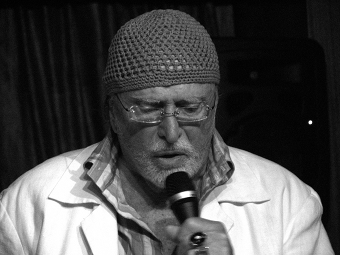
Back when it was hip to be hep, to paraphrase Dave Frishberg’s famous lyric, Mark Murphy was hep. But beyond that, the legendary jazz singer is so overwhelmingly hip, so devastatingly hip, so torrentially hip that he could be hep if he wanted to and suddenly hep would be hip all over again. Murphy’s all-pervasive hipness is one of those ineffable facts of existence that’s so obvious it’s not even worth arguing over, like the crying of children in Iowa and the coming of complete night that blesses the earth.
The major question regarding Mark Murphy right now is not how hip he is, but how long can hipness endure? The last time I saw him—and I believe his last big gig in New York—was at Dizzy’s at Jazz at Lincoln Center in March 2007, to celebrate the release of his latest album, Love Is What Stays, and, although he didn’t mention it at the time, his 75th birthday. Up to that point, Murphy was a marvel of longevity: with his footballer’s physique and famously big hair, he looked exactly the same as when I first began seeing him in clubs 25 years earlier, a time traveler who appeared to have stepped directly out of the age of hepness and hipness (let’s face it, no one is even “hip” anymore either, unless they’re really kicking it old school, dawg).
(His most recent recording appears to be four tracks on Songs from the Last Century, by the French piano and bass team Guillaume De Chassy, Daniel Yvinec, and also guest-starring Paul Motian. Murphy sounds remarkably strong here, recorded in March 2008, according to Lord, and available for download here.)
Then, all of a sudden, rumor had it that time was catching up with La Murph. In May of 2009, a mass email was circulated that announced “time is running short to spend time with Mark before his Alzheimer’s overtakes him.” Obviously, this news caused a great deal of speculation and concern amongst the singer’s friends, since he knows practically everyone in the jazz world (Lord knows how many contemporary singers are his former students). There was no confirmation or denial from Murphy himself, but the general absence of upcoming gigs on his website was certainly not a good sign. In fact, he currently has only three shows on his schedule: Chicago in May, the Kitano in New York at the end of July, and San Francisco in October.
So with anticipation running high, my wife and I reserved a seat at the Kitano (a Japanese-owned hotel on Park Avenue and 38th Street that features jazz several nights a week). By early in the week, all four shows scheduled for Friday July 31 and Saturday August 1 were already sold out; fortunately we muscled our way into the late show (after catching the brilliant Freddy Cole at Jazz Standard).
As another sage named Mark once wrote, reports of Murphy’s demise were exaggerated. Although he now walks with a cane and sings sitting down, he looks really good: he’s let his beard go white, and has given up the infamous high hair for a tasteful knit cap, and he’s neither gained nor lost any weight. His chops are in terrific shape, although his concentration isn’t entirely what it used to be. He sang with a trio led by pianist Jon Cowherd (best known as a member of Brian Blade’s Fellowship), Muscovite bassist Boris Kazloff (introduced at least once by Murphy—for a laugh—as “Boris Karloff”), and drummer Willard Dyson.
After Cowherd’s opening instrumental (Freddie Hubbard’s “Up Jumped Spring” —a cool tune for the first of August), Murphy took the mike and led us through what can only be described as an extended meditation that involved five songs: “Night and Day,” “Señor Blues,” “Photograph,” “Stolen Moments,” and “Too Late Now.” He started with Cole Porter, phrasing the tune in an extravagantly swinging, exaggeratedly staccato fashion; he spends a lot of time scatting, and, beyond that, making wildly nonsensical sounds, but, as always, Murphy extracts more coherent meaning and emotion out of scat phrases that most contemporary singers do with actual words.
From Porter, Murphy took a Mexican Hayride into Horace Silver’s famous south of the border excursion, which he sings in the first person, referring to himself as “Señor Blues” (in this case it’s also “Senior Blues”) with a Mel Blanc accent rather like Peggy Lee doing “Mañana.” In addition to scatting again and ululating in a vaguely Hispanic fashion, he also comments on his own Irishness. Traveling further south, he took us to Brazil for “Photograph,” a rare Jobim tune that isn’t done to death.
At this point, we gradually became aware that Murphy was in the middle of a spoken monologue with trio accompaniment that segued in and out of the remaining songs. He began his own lyric to “Stolen Moments,” but gave it up halfway through for more wordless communication, and then launched into “Too Late Now.” Throughout this whole final segment, he kept rambling about the heroes of the film Brokeback Moment and how they had to steal moments together (“out washing sheep in Mon-f**king-Tana” as he put it) and how curious it was that “Too Late” was written for a girly soprano like Jane Powell (in Royal Wedding). I’m herewith organizing Murphy’s thoughts for him in a rather pedestrian and linear way; the way he did it at Kitano, drifting from a stretch of lyrics into a spoken observation, then back into song, was mesmerizing.
After being on for 50 minutes or so, Murphy abruptly stopped, took a small bow and walked off. He was, understandably, exhausted after four shows in two nights. (The next day, a Murphy fan emailed me a recording of the earlier Saturday show, which was only slightly longer but included seven different songs, one of which was his own beautiful torch tune, “Before We Say Goodbye,” which, as far as I can tell, he’s only recorded in an electronic, acid-jazz setting.)
Overall, Murphy sounded great, and it was one of the most moving of all the dozens of performances of his that I’ve attended. I was tempted to end by saying it’s too late now and all our moments with Señor Blues feel like stolen ones. Instead, when I talk about this—and I will—I’m not just being kind when I say that although I can’t deny that Murphy has started to lose it, he still has a lot left—more than nearly anyone else singing today. Like, I’m hip.
Postscript: Videos from this engagement can be seen here
This blog entry posted by Will Friedwald
Tags:

Comments are closed.