The Jazz.com Blog
September 01, 2009 · 0 comments
Keeping Track of 1,144,341 Jazz Tunes
Will Friedwald has contributed a series of articles to jazz.com focusing on the great discographers of jazz. For previous installments go here, here and here. He continues his investigations below with a profile of Tom Lord, whose online discography covers more than one million songs and close to 200,000 sessions. T.G.
If you own an iPhone or follow the world of consumer technology, you'll doubtless be familiar with the term "iPhone Killer"�every rival piece of equipment to be marketed by a competitive manufacturer (ie the new revised Blackberry) has been touted as an �iPhone Killer.�
Not for long however, the iPhone shows every sign of being unkillable, and likewise, for most of my life, Brian Rust�s Jazz Records 1898-1942 just could not be �killed.� I accumulated dozens of other discographical books through the decades, but nothing could replace the basic Rust two-volume set, which I had permanently opened on my desk. Even into the age of CDROMS and digital data, and the first decade or so of the world wide web, it seemed like Rust�s durable volumes were unkillable. (If anything could �kill� Rust, it was the way I ransacked it every day that left the two volumes literally falling apart; some collectors I know have had their editions re-bound.)
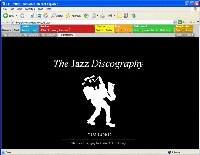
It�s only now that I�ve been using Tom Lord�s Online Jazz Discography for nearly two years that I realize that I have hardly opened Rust Jazz Records since 2007. Somehow, even having Lord on CDROM wasn�t enough to displace those big green Arlington House books. But now, God help me, I�m actually considering the once unthinkable option of putting JR into storage (especially in my new, smaller apartment, where every inch of space counts). The Rust books put out to pasture�have mercy!
Rust gives you more than just the original issue: he lists English, and, in some cases, overseas pressings. Even in the 1930s & 1940s, classic tracks, like those by Jelly Roll Morton and King Oliver, were reissued repeatedly while still within the 78 era, on specialist labels like Hot Record Society and Commodore, and Rust tracks all of these. Lord goes considerably farther, trying to keep on top of all known LP and CD issues; there�s practically no end to the number of times that Louis Armstrong�s Hot Fives or the Teddy Wilson - Billie Holiday sessions have been reissued and re-re-re-re-issued ad nausem, particularly under the European copyright law where virtually anything goes (in terms of material over 50 years old). Even dealing with the pre-war era alone, the details of the zillions of redundant reissues is an overwhelming task.
Another useful feature of TJD online is a feature that lets you see which releases have been added in the past one to 31 days. The �new issues / reissues tab� is a thoughtful application that could only exist in an online edition. It shows how the web has enabled TJD, unlike any printed volume, to become a living, breathing organism. (Hey! There�s a whole bunch of new Sun Ra reissues, taken from the interplanetary guru�s own Saturn Records label.) Like any Internet entity, TJD is more of a two-way dialog with readers than a book could be, in that Mr. Lord reviews additions and corrections from readers (even me!). But mostly he just adds, and adds and adds, between brand new releases and reissues, he estimates that about 600 releases per month go up on the listings. (One that I�m very psyched to see go up recently is The Anachronic Jazz Band, a particularly hip French ensemble that specialized in traditional jazz arrangements of modern jazz classics�ie, �Giant Steps� rendered a la King Oliver.)
Looking at the several hundred titles added in July 2009 brings up another point: Jazz is essentially an American music, but TJD is the first major general discography compiled on the North American continent (compared to Charles Delauney, Brian Rust, Jorgen Jepsen, Walter Bruyninckx and Erik Raben�whom Mr. Lord acknowledges). A significant portion of the contemporary albums being added are by musicians who have never come to New York to play the Village Vanguard or Dizzy�s, and, as I�ve mentioned in this column before, Mr. Lord has gone to the trouble to include details of many European bands going back to the Jazz Age.
As he reports, �I have sessions in the database from the Dutch Jazz Discography, Swedish Jazz Discography, Norwegian Jazz Discography, Swiss Jazz Discography, Hungarian Jazz Discography, Belgian Jazz Discography, Australian Jazz Discography, Canadian Jazz Discography, etc. They all have information that isn�t in Rust.� I recently obtained a CD anthology of European swing that includes �Rag Mop� by a Berlin trombonist, hitherto unknown to me, named Walter Dobschinsky (you haven�t heard �Rag Mop� until you�ve heard it in German). I was then fascinated to discover through TJD that Dobschinsky was a storied bandleader who was playing hot jazz in Germany back to the early Nazi era. (His name seems to be given as both �Dobschinsky� and �Dobschinski� in different sessions in TJD, but Lord is working to straighten out such inconsistencies.)
I will leave it someone with an internationalist axe to grind to try and use TJD to make a point with regards to what Stuart Nicholson has described as the �glocalization� of jazz. Such a statement would be impossible to qualify in terms of the entire work, since the sheer volume of information include in TJD online is almost frightening. To compare the statistics listed from a year and a half ago, with the current count:
January 2008 |
July 2009 |
|
| Leaders | 34,861 | 36,969 |
| Recording sessions | 181,392 | 189,629 |
| Musician entries | 1,030,109 | 1,077,379 |
| Tune Entries | 1,077,503 | 1,144,341 |
One helpful piece of advice is to acclimate yourself by reading the �useful tips,� section on the left hand side of the sign-in page; there�s a lot of hints on how to get around, how to follow a musician from date to date and how to follow a song from musician to musician. One point I missed until recently is that it is possible to narrow down the date range of a particularly prolific musician. For instance, to follow Duke Ellington from after 1935, go to the leader search and enter �Duke� and �Ellington,� then, once you�re in the Ellington listing, you can go to a specific date by clicking on the red tab labeled �Date Search,� on the top of the frame, mid-left side. Enter 1935 (or even a year, month, and day) and you can find everything by that artist from that date onwards. It�s very useful, and I could have saved a lot of time had I known about it earlier.
The Jazz Discography is the kind of work that you spend a lot of time with; I imagine that I�m on TJD at least as much as Wikipedia, the All-Music Guide, or the Internet movie database and Broadway database (and one subject for a future column, the marvelous online discography project, which isn�t a session-oriented discography like Rust or Lord, but a massive set of 78 RPM number catalogs, and another resource that I check all the time) all put together. (Even so, the day when Rust�s other seminal works, The American Dance Band Discography, The Complete Entertainment Discography and British Dance Bands are similarly superseded by a digital successor seems a long way in the future.) Quite possibly the best thing about the Online Jazz Discography is that, as much as I use it, it won�t fall apart and force me to have it re-bound.
This blog entry posted by Will Friedwald
Tags:

Comments are closed.