The Jazz.com Blog
September 14, 2009 · 0 comments
The Artistry of George Russell (Part 2)
A few days ago, jazz.com published part one of Jeff Sultanof's overview of the life and music of the late George Russell. Sultanof concludes his article below. T.G.
In 1957, George Russell was commissioned by Brandeis University to compose “All About Rosie,” a three movement composition which is quite possibly the composer’s masterpiece. It is one of the few pieces of concert music using the language and instrumentation of jazz that is fully convincing. Not until movement three do we hear improvised solos, but Bill Evans’s is one of his greatest—in fact, it was transcribed for inclusion in the full score of the work published by Margun Music and now available from Music Sales (Schirmer). Russell later re-orchestrated the piece for the Gerry Mulligan Concert Jazz Band, and in some ways the resulting recording was better than the original.
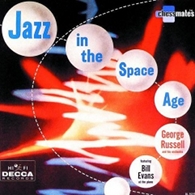
Milt Gabler at Decca Records took an interest in Russell when the composer wrote some new pieces for Hal McKusick’s Decca albums, and he produced Russell’s next two projects, both gems—New York, New York and Jazz in the Space Age. The first of these albums, with an all-star big band, had many compositional and improvised highpoints. Bob Brookmeyer, Art Farmer, Max Roach, Phil Woods, Benny Golson, John Coltrane and Bill Evans are featured. The second is an album-length composition broken into several sections in which Russell continued to explore form and the written vs. the improvised.
Bill Evans once again is outstanding and Paul Bley plays against him brilliantly. Even though the entire piece is over a single or several rhythmic patterns, a few of the soloists play quite freely (Bley and Evans sometimes ignore the beat entirely). Russell uses a bass line in 5 for several sections; he’d used such a bass line in “All About Rosie” as 5 against 4.
Critics were ecstatic over these albums. Ornette Coleman had arrived on the scene and his Free Jazz approach shocked and disturbed many faithful jazz critics and listeners, and Russell was showing how jazz composition could go in a new direction that they had some chance of understanding. At the same time, Miles Davis was moving in the direction of modal improvisation directly influenced by Russell’s concept, and Kind of Blue became the war-cry for the new jazz. On the one hand, modes freed up the soloist to explore new directions in melody and harmony. On the other, soloists with minimal talent now played endless solos over one or two chords.
Musicians now beat a path to Russell’s Bank Street apartment to learn the concept, and Russell’s new sextet included students of his (David Baker, Al Kiger) along with more experienced musicians, over the years including Don Ellis, Eric Dolphy, Chuck Israels, and Steve Swallow. Carla Bley wrote one of her earliest compositions for this group. The group made four excellent albums for Riverside Records (all of which are available on CD).
However by 1964, Russell was one of many jazz musicians who felt the pinch of the British invasion of rock and roll. Jazz clubs were switching to rock, record labels cut back on jazz product, or ignored the music entirely. Russell had a gig in Europe and decided to stay there. Scandinavia became his home for several years, where he taught such musicians as Jan Garbarek and Terje Rypdal. Bosse Broberg, the conductor of The Swedish Jazz Orchestra asked Russell to write for his ensemble. Many of Russell’s compositions were commissioned and premiered by that organization.
It was in Europe that Russell further explored a compositional idea he called “Vertical Forms.” In essence, he would create ostinato rhythms or lines, and they would repeat, expand and contract while other musical materials and improvised solos would play over them. At this point, his musical palette took in jazz, rock, Latin rhythms, Free Jazz, and even electronic tape for his work “Electronic Sonata for Souls Loved by Nature.” Like Gil Evans in the seventies and eighties, Russell embraced the popular music of the time, and was met with great interest by adventurous listeners, and dismay and indifference by his older fans. Some of the early “Vertical Form” pieces sound repetitive and directionless to these ears, but Russell continued to explore and refine.
In 1969, Gunther Schuller was the director of the New England Conservatory, and perhaps one of the most important things he did was hire Russell to teach the Lydian Chromatic Concept at the Conservatory. As he had shown for years, Russell was a born teacher and students flocked to his classes. He began to tour with a big band; a later edition of the band was called the Living Time Orchestra.
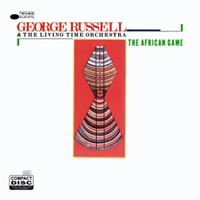
In 1985, the then-dormant Blue Note record label was revived with two albums from the same Russell big band concert recorded in Massachusetts. One of the albums, The African Game, was one of Russell’s finest achievements and was nominated for two Grammy Awards. Several years later, I heard a live performance of this work played by the New England Conservatory Jazz Ensemble at an International Association of Jazz Educators convention, and the piece and the performance received a well-deserved standing ovation. As an important innovator in World music, Russell was honored with a MacArthur “Genius Grant” in 1989, the 1990 National Endowment for the Arts American Jazz Master Award, two Guggenheim fellowships and several other honors.
By 2001, the Concept was available in a newly revised and final version. A beautiful hardcover book, it cost a whopping $125.00, hardly a casual purchase. But Russell and his wife Alice had a booth at the previously described IAJE, and I was one of many people who bought a copy and asked Russell to sign it for me. The man seemed tired but happy to see the long line of people buying his book. I did not know that he probably had the beginnings of Alzheimer’s, but I had a pleasant chat with his wife Alice, during which I informed her that I’d found one of George’s pieces in Miles Davis’ collection of music, and urged her to contact Peter Shukat so George could obtain a copy. I then asked why Russell did not make his music available. Alice said that George was very concerned about photocopying.
While I understood his concerns (as I’ve written on this website and elsewhere, there are some real crooks who have pilfered one-of-a-kind manuscripts of big band pieces from major collections; others have sold copies of them illegally), if he would have appointed a print licensee, much of his music could have been made available and he could have realized income from copies sold.
The fact was that Russell did not want his music available and he wanted to control how his concept was taught. If one needs proof, the following sentence may be found in all four editions of the Lydian Chromatic Concept: “The teaching of all or any part of this material by unauthorized persons is an infringement of copyright.” In fact, when he gave weekend courses on the concept outside of Massachusetts, the advertising promised new material that was not yet available except at these weekends. Ironically, in the 2001 edition, he made it clear that this was Volume 1 and that Volume 2 would be available at a later time. To date, it has not appeared. Will it ever be published, and under what circumstances? Will the concept become one of those interesting ideas that was once influential and eventually disappear, such as The Schillinger System (once THE course of study for professional arrangers from the thirties through the sixties)?
It is my hope that the estate does what is necessary so that Volume 2 of the concept is published, and that his students organize in some way so that the concept can continue to be taught by those who have thoroughly absorbed it. The text itself is dense and requires working through a great deal of information and sounds that run counter to traditional harmony. But the result is more than worth the trouble.
Thankfully, George Russell’s contributions to music were recognized during his lifetime, and he did not die penniless and unknown. But now is a crucial time to assure that his legacy continues and thrives.
This blog entry posted by Jeff Sultanof
Tags:

Comments are closed.