The Jazz.com Blog
September 16, 2009 · 0 comments
Ron Carter, Mulgrew Miller and Russell Malone in DC
Michael J. West, a regular contributor to jazz.com, reports below on the performance by an all-star trio at Bohemian Caverns. Ron Carter came without a drummer, but hardly needed one with pianist Mulgrew Miller and guitarist Russell Malone on hand. T.G.
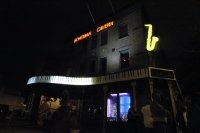
Washington, D.C.s Bohemian Caverns is a rare breed: a jazz club thats operated out of the same locationa U Street basement whose speakeasy origins are obviousfor nearly 90 years, making it a truly historic venue. The last time I was here, it was with Miles Davis in 1964, Ron Carter told club owner Omrao Brown, making a sweeping gesture at the clubs fake rock walls. But Friday evening, the legendary bassist returned, this time as a leader. His all-star Golden Striker trio (featuring pianist Mulgrew Miller and guitarist Russell Malone) did a sterling performance of jazz standards that they kept low-key, but also infused with an overpowering but sublime sense of the blues.
For Fridays 10:30 set, Carter, Miller, and Malone, dressed identically down to the green-and-blue striped ties, took the stage without a wordclimbing over the tables crowding its front to compensate for the packed houseand opened on a mellow rendition of Jimmy McHugh and Dorothy Fields Dont Blame Me. The pianist took the lead very early, carrying the written melody and the first solo. Hank Jones has called Mulgrew Miller one of the greatest living pianists, and in concert its easy to see why; he belongs to the same lineage as Jones, caught between early and modern traditions. Miller played a stride line on his left hand and light bebop figures on his right that were built on sly blue notes, groaning under his breath with the right-hand phrases.
Malone was even softer. Much more restrained from the showmanship he exudes as a leader, the guitarist focused instead on his tone, clear and so naturalistic that the click-click attack of his guitar pick was audible through his Roland amp. On the bands second tune, a super-fast Oleo, it was often the only audible sound in his amp; Malone played accompanying chords, but so softly it was as if he was stroking the strings with a brush. One had to listen intently for the notes. He also turned the guitar into a percussion instrument, ceasing his comp shortly into Millers solo to begin patting the surface of his Sadowsky archtop like a bongo drum. Malones solo was pointed but very precise, with amazing speed that brought to mind Louis Armstrongs onstage Tiger Rag shtick about how the tiger was fast, but the band could outrun him.
As for Carter, he did what he always does: make the most convoluted, difficult runs of bass notes sound lyrical and look easy. He was subtle and economical on Dont Blame Me, but turned around and blew the crowd away on Oleo. Throughout Miller and Malones solos he was incredibly stable and solid, even at the tunes crazy tempo, and maintained that nimble rhythm in his own solobut his harmonic progression was in another realm, as though he were playing the changes on an adjacent but completely separate song. It was the next segment, though, that had real majesty. Malone delicately chorded a dark little structure, with Miller playing broken time against him; Carter equaled them for delicacy, although his confidence shone through every note.
Then, on a dime, piano and guitar fell away and Carter took off on an odyssey. His fingers floating all over the neck and even strumming there at several points, he zoomed through double stops, note bends, slides, harmonics, blues fragments, and quotes from Willow Weep for Me and All Blues. (When he briefly quoted from The Mickey Mouse Club, a shout came from the back of the room: Thats what Im talking about!) Despite his grimaces and the sharp barbs he played, Carter made the whole musical trek a thing of fragile grace; it looked as though any one of us in the club could have gotten up and replicated his every move without a second thought.
It was at the conclusion of that magnificent showpiece that Carter finally introduced the band. They have the same taste in ties that I do, he joked, And they accept postdated checks. He then called Autumn Leavesa song the trio had first performed on The Golden Striker, the 2003 album that gave them their namesuch a common standard that musicians tend to know if reflexively, but in this case the arrangement had Miller and Malone carefully reading charts. But they nonetheless made it a triumph, Miller with a gospel-ballad tack and Malone following with a slightly sharper course that echoed Miles Walkin.
Finally, though Carter had announced Autumn Leaves as their closing number, they threw in one more: Fletcher Hendersons Soft Winds. This piece was so bluesy that it was actually deceptive: This writer was convinced it was a standard 12-bar until counting the measures and finding 32 of them to a chorus. Yet it was stocked with blue notes and blues changes, and the hard-bop flavor was so strong that Miller took an extended quote from Nat Adderleys Work Song. Carter and Malone added to the blues atmosphere, while simultaneously playing endlessly melodic chords around and behind Miller before drawing to a close with a subdued reading of the melody.
It was a bit of a curveball from Ron Carter; the dexterous bassist certainly exercises tasteful restraint, but the delicacy and subtlety of the Golden Striker trio was a horse of a different colorblue. It did, however, make for an extraordinary night of music.
This blog entry posted by Michael J. West
Tags:

Comments are closed.