The Jazz.com Blog
February 03, 2009 · 0 comments
A Giant's Steps: John Coltrane on Atlantic (Part Two)
Chris Kelsey, an editor and regular contributor to jazz.com, continues his survey of John Coltrane's work for the Atlantic label. These recordings, often over-shadowed by Coltrane's later work for the Impulse label, include some of the tenorist's most historic and influential work. Click here to read part one of this article. T.G.
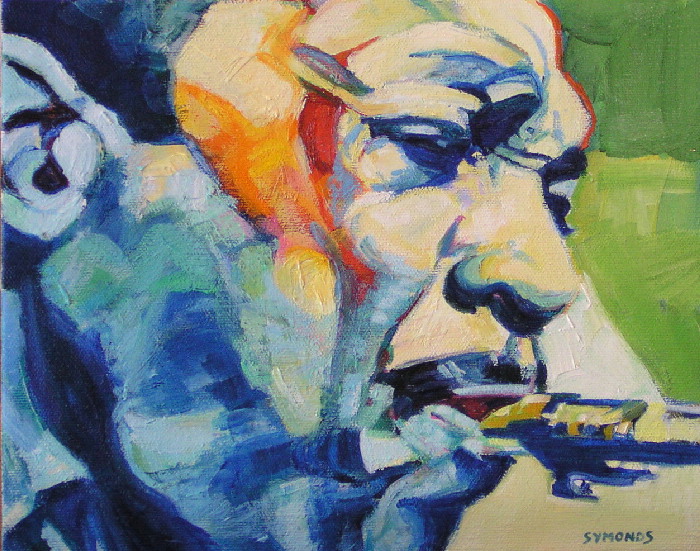
The contract John Coltrane signed with Atlantic guaranteed the saxophonist seven thousand dollars per year for its durationnot a king's ransom, certainly, but in 1958 a more-than-respectable sum. More importantly, it seems to have allowed Coltrane the luxury of time in preparing his record dates. No longer being paid strictly by-the-session must surely have allowed Coltrane to plan his record dates more thoroughly, resulting in music that was more reflective of his evolving musical personality (Giant Steps being a prime example).
The Atlantic contract might also explain his slimmed-down discography. In '57 and '58, Trane practically lived in the studio. In '59, he recorded much less oftenas a sideman, only twice, not counting unofficial live recordings. In February he recorded Cannonball Adderley Quintet In Chicago for Norman Granz's Mercury label, and in March and April (just before and after the first Giant Steps session), Miles Davis's legendary Kind of Blue for Columbia.
After Giant Steps, Coltrane's next Atlantic sessions happened on November 24 and December 2, 1959, resulting in Coltrane Jazz ("Naima" from Giant Steps was also recorded at the latter session). For a rhythm section, Coltrane used his pals from Miles' band: bassist Paul Chambers, pianist Wynton Kelly, and drummer Jimmy Cobb.
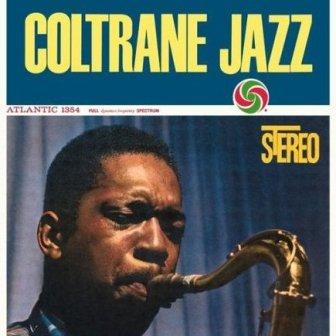
Coltrane Jazz opens with Hoagy Carmichael's "Little Old Lady," a singsong-y trifle reminiscent of the unlikely show tunes Sonny Rollins excavates and transforms so brilliantly. Coltrane does a similarly fine job, imbuing the tune with a lilt and spirit befitting its light-hearted nature. Coltrane's original composition "Like Sonny" makes an explicit reference to Rollins, both in the title and in the Sonny-ish way it interpolates a slight melodic figure. Coltrane also makes good work of three blues originals, notably "Harmonique," a tune written in 6/4 time that features extensive use of multiphonicsa technique by which Coltrane produces multiple tones simultaneously, by means of false-fingerings and manipulation of his embouchure.
Coltrane Jazz wasn't a landmark recording in the mold of Giant Steps; it didn't address any gargantuan harmonic challenges, or otherwise introduce any radical shifts. To contemporary ears, Coltrane's choice of sidemen serves to make the record sound a bit like a Miles Davis record without Miles. However, it's an excellent work by any reasonable standard, and serves nicely as a sort of farewell by Trane to what was, at that moment, Davis' signature ensemble conception. Coltrane would not use Miles' rhythm section on subsequent record dates although, for his next album, he would borrow sidemen from another noteworthy source.
On June 28 and July 8, 1960, Coltrane entered the studio, accompanied by members of alto saxophonist Ornette Coleman's band: trumpeter Don Cherry, bassist Charlie Haden, and drummer Ed Blackwell (bassist Percy Heath replaced Haden on the July 8 session). A year prior, the ingenious autodidact Coleman had rocked the jazz world with his own Atlantic recordings, and an appearance at the Lenox School of Jazz. Cherry was particularly adept at Coleman's free-floating, quasi-modal method of improvisationa style that mostly retained bebop rhythms, but was otherwise centered on the nearly impulsive creation of melody, unbound by preordained harmonic constructs.
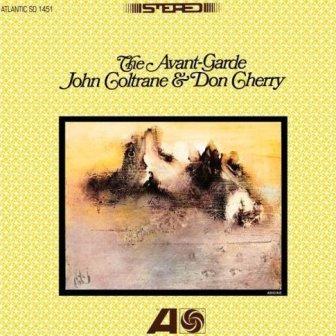
On the resultant album, The Avant-Garde, Coltrane willingly takes a "when in Rome " tack, adapting to Coleman's method, and essentially letting his sidemen do their own thing. Coltrane and Cherry work remarkably well together, playing-down a repertoire of tunes by Coleman, Cherry, and Monk, articulating the oftentimes knotty melodies with the requisite loose precision. On "Cherryco," Coltrane's improvisation embodies his idea of starting in the middle of a sentence and completing it in both directions at once. Bereft of clich, his solo abandons bebop rhythms for an unfettered style not beholden to the beat. On other tunesfor example, Thelonious Monk's "Bemsha Swing"he swings more explicitly, yet retains the element of rhythmic instability that keeps this listener on the edge of his seat. Cherry more than meets the challenge of playing with Coltrane, contributing some of his most inspired playing on record.
The rhythm section sounds a bit tense, and even tentative, at times. So does Coltrane, truth be told. We see in retrospect that this was a meeting of sympathetic if not altogether compatible musicians. Still, the performances are of a high caliber, and the album is nothing less than fascinating, especially as evidence of Coltrane's burgeoning interest in "free" music.
Contemporaneous to the recording of The Avant-Garde, Coltrane was in the process of forming a working band. Over several months in 1960, this quartet-in-the-making included Steve Kuhn or McCoy Tyner on piano; Steve Davis on bass; and Pete LaRoca (Sims), Billy Higgins, or Elvin Jones on drums. By late Octoberin time for his next Atlantic sessionsTrane had settled on a line-up of Tyner, Davis, and Jones. Those three sessions produced enough music for three-plus albums: My Favorite Things, Coltrane's Sound, and Coltrane Plays The Blues ("Village Blues" from Coltrane Jazz came from these sessions, as well).
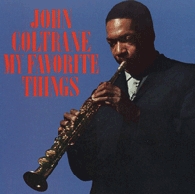
My Favorite Things is one of those rare acoustic jazz albumslike Miles' Kind of Blue and Dave Brubeck's Time Outthat scored widespread popularity with a general audience, thanks mostly to Coltrane's iconic cover of the title tune, taken from the 1959 Rogers and Hammerstein Broadway musical, The Sound of Music.
Besides being an exceptionally beautiful piece of music, the title track is notable for other, more prosaic reasons. For one thing, Coltrane plays soprano sax, a horn he'd been woodshedding in private and (with the exception of "The Blessing" from The Avant-Garde, which would be released after My Favorite Things) had not played on a commercial recording. Additionally, the performance is based on modes rather than a series of chord changes, a harmonic strategy Coltrane would use with increasing frequency in coming months and years. Also significant is the track's length; "My Favorite Things" clocks-in at almost 14 minutesan unusually long performance for that era. The extended playing time and the accompaniment's drone-ish harmonic scheme better-enabled Coltrane to build his solo in a dramatic arc: from simple to complex and back, both in terms of ideas and emotional intensity.
Elsewhere, "Summertime"'s simple minor-key harmonies allow a similar sort of organization. On his arrangement of the standard "But Not For Me," Coltrane takes the opposite approach, going for harmonic complexity in recasting the tune using "Giant Steps"-style changes. Coltrane takes out the soprano again on "Every Time We Say Goodbye"something of anomaly in the context of his subsequent work, in that the tenor would remain his "ballad horn," for the most part.
The album's final revelation concerns its personnel. The teaming of McCoy Tyner and Elvin Jones sparked an extraordinary dynamic that was to animate this band in years to come. Already, Tyner's unique voicings and muscular style lend the music a sound unlike any in jazz at the time, and Jones' drummingwhile not as overtly intense at it would soon beis a pot of simmering polyrhythms on the verge of boiling over. The ensemble performance on My Favorite Things hints at conceptual changes to come (especially Coltrane's infatuation with free jazz), yet retains a palpable connection to the past. That quality of combining tradition with a vivid sense of exploration is likely part of what makes the album a perennial favorite of not only hardcore jazz fans, but also music lovers with only a passing interest in jazz.
This is the end of part two of Chris Kelsey's article on John Coltrane's Atlantic years. Part three can be read here.
Tags:

Comments are closed.