The Jazz.com Blog
April 16, 2009 · 2 comments
Nat Hentoff: At the Constitutional Jazz Band Ball
Nat Hentoff recently joined on as contributor to jazz.comyou can check out his previous articles here and here. Hentoff is a leading jazz advocate, and was the first non-musician to be honored as a Jazz Master by the National Endowment for the Arts, but he is also a longstanding commentator on political and judicial matters. Today he wears both hats, and reports on that rarest of events: a meeting of Art and Justice. T.G.
One of my day jobs is covering the Supreme Court. During Justice Sandra Day O'Connor's years there, she was often the swing vote in 5-4 decisions. At her most swinging, however, was her decision for the Court in Hamdi v. Rumsfeld (2004) when she reprimanded George W. Bush for having imprisoned an American citizen for years without any review by a judge as "an enemy combatant."
In a stop chorus, O'Connor swung hard.
"We have long since made clear that a state of war is not a blank check for the President when it comes to the rights of American citizens."
What I didn't know about Justice O'Connor until a January 19 celebration this year of Martin Luther King's birthday was that her devotion to free expression includes jazz.
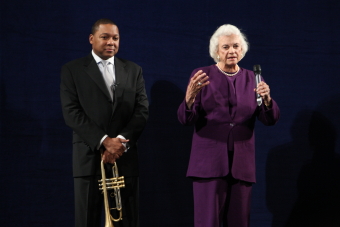
On that date, leading into the inauguration next day of President Barack Obama, Jazz at Lincoln Center and the Rockefeller Foundation presented "A Celebration of America" concert at Kennedy Center, which emphasized that Dr. King had called jazz "America's triumphant music."
Part of that event was a conversation between trumpeter Wynton Marsalis and the former Justice O'Connor who, at 78, has started a website, www.ourcourts.org,which aims to bring the Constitution off the pages and into the lives of middle-school kids and their teachers. She's still swinging!
Sandra Day, having grown up on a ranch in Arizona, recalled liking "the fun" of country-western swing. Wynton said he vaguely knew about that. I strongly recommend that he, and jazz.com's readers, check out The Tiffany Transcriptions, by Bob Wills and his Texas Playboys on the Collector's Choice label. Now that is the joyous essence of country-western swing.
But, O'Connor added, she wasn't exposed to "what we think of as jazz until I went to college at Stanford." At a freshman dance, she met a young man, a banjo player, who loved jazz. "We made many a visit to hear Kid Ory and his band. Also, I liked Louis Armstrong a lot. How could you not? He was pretty dazzling. And I liked Cab Calloway, he had a good beat for dancing."
Wynton started earlier, he said, at age 12 or 13 with John Coltrane. Then Wynton said something that, if we still had civics classes in this nation, would show students the connection between jazz and the Constitution.
"One of the beautiful things about jazz improvisation is that you can take something that we all know, and you can make it into another piece, but it still keeps its identity. It's like how the Constitution can be amended. It's still the Constitution, but here's our take on it. That means it is always new because the ideas are valid, they're timeless."
Too bad Supreme Court Justice Antonin Scalia doesn't dig that. He scorns the concept of an evolving Constitution.
One of the reasons Justice O'Connor started her new website was that "polls say only about one-third of Americans can even name the three branches of government, much less say what they do." George W. Bush and Dick Cheney counted on that widespread ignorance.
In the conversation with Wynton, O'Connor, still spreading the constitutional gospel, said: "The great contribution the framers of our Constitution was developing the three separate branches. The Presidency, the Legislative Branch and the Judicial Branch."
"And, Wynton chimed in, "they worked through those problems by a delicate way of balancing individual rights, the rights of states, and the central government's role. And in music we do that all the time. The president is the drum. The bass is the judiciary. There was a great player named Milton Hinton."
"Bass keeps them steady," said Sandra Day O'Connor.
"That's right," Winton agreed. "Milt Hinton was called 'The Judge.'"
And what's the equivalent of the legislature in jazz? "The piano and the rhythm section," said Professor Marsalis. The piano represents all of the notes, all of the keys."
Digging the lesson, O'Connor interrupted, "And when one of you is playing solo, the others play along but they listen, don't they!"
"That's right," said Marsalis. "One of the greatest lessons on the bandstand is you're forced to listen to everybody else. So it teaches you to be open in your hearing."
Sandra Day O'Connor having spent time as a member of the Arizona legislature before having to give final grades to the often discordant products of State and Congressional legislatures as a Supreme Court Justice responded with a fervent hope:
"Well now, if we can just get members of legislative branches to pay a little more attention to the theory of jazz music, we'll all be better off, don't you think?"
Wynton heartily agreed. And my suggestion to Sandra Day O'Connor is that she add some jazz to her website to move middle school students into the intersecting rhythms of the Bill of Rights and Lester Young, Duke Ellington and Thelonious Monk, among other jazz educators in how, as Martin Luther King said, "Jazz speaks for life."
Add blues to the website, too, Justice O'Connor. At the Berlin Jazz festival 45 years ago, Dr. King said: "The blues tell the story of life's difficulties They take the hardest realities of life and put them into music, only to come out with some new hope or sense of triumph."
There's so little jazz on television, including public television, that in the midst of all the controversy about reforming education, why not a series on PBS, or elsewhere, with hosts Wynton Marsalis, Sandra Day O'Connor and guests from the jazz life and the judiciary. Some of the latter may get tuned into the rhythms of the living Constitution. Call it: "At the Constitutional Jazz Band Ball!"
This blog entry posted by Nat Hentoff
Tags:

Sounds like a fun conversation. Why not also get bankers and jazz players together to discuss the subject of borrowing and paying back. Oh yes, and "bailouts." I was talking to a musician yesterday who had just played a big party hosted by State Street Bank in Boston. He said they were making funny up on the podium, such as "We checked with the Treasury before scheduling this party," and "We do not charter any jets, and all our bankers fly coach," and "Due to economic conditions in America, tonight will be a cash bar only....(beat)....NOT." The musician on the gig was a pro who said his income had dropped from $60k a year to $30k and he said he wasn't a big spender....but rent was high.
Mazel Tov to Jazz.com for this wonderful article by Nat Hentoff. This egalitarian artform called jazz and our constitution; two supreme accomplishments of our civilzation, both deserve renewed attention and support. Mubarik, Nat and company. Live and be well. Eric Alabaster